What Triggers an HMRC Tax Investigation? 10 Red Flags
An HMRC tax investigation is something every business owner wants to avoid. While only a small proportion of taxpayers are investigated each year, the consequences can be stressful, time-consuming, and expensive. Understanding what triggers an investigation can help you stay on the right side of HMRC. Here are the ten most common red flags that can put your business under the spotlight.
1. Late or Missing Tax Returns
One of the simplest ways to attract HMRC's attention is to file your tax returns late or not at all. HMRC's systems automatically flag taxpayers who miss deadlines, and persistent late filing suggests either disorganisation or deliberate avoidance. Self Assessment returns are due by 31 January following the end of the tax year, and VAT returns are due one calendar month and seven days after the end of each VAT period.
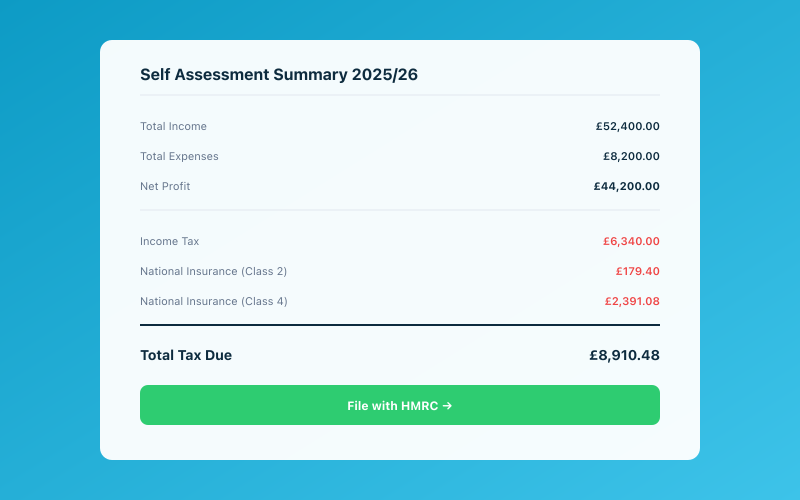 Your Accounted dashboard shows your real-time tax position
Missing deadlines does not just trigger penalties. It signals to HMRC that your record-keeping may be inadequate, which makes you a more likely candidate for an enquiry. Filing on time, every time, is one of the easiest ways to keep a low profile.
2. Large or Unusual Expense Claims
If your expense claims are significantly higher than others in your industry, HMRC's risk profiling systems will notice. This does not mean you cannot claim legitimate expenses, but if your expenses as a proportion of turnover are abnormally high, expect questions.
Common areas of scrutiny include travel and subsistence, motor expenses, use of home as office, and entertainment. HMRC has detailed data on typical expense ratios for every industry sector, and significant deviations will raise a flag.
Ensure every expense you claim is wholly and exclusively for business purposes, and keep receipts and records to back up every claim. If an expense has both a personal and business element, only claim the business portion.
3. Income Inconsistencies
HMRC receives information from many sources, not just your tax return. Banks, building societies, and other financial institutions report interest payments. Employers file PAYE data in real time. Online platforms report seller income under the OECD's DAC7 rules. Land Registry records property transactions.
If the income you declare on your tax return does not match the information HMRC receives from these third parties, an enquiry is likely. Even honest mistakes, such as forgetting to declare a small amount of bank interest, can trigger a review.
4. Cash-Heavy Businesses
Businesses that handle a lot of cash, such as takeaways, market traders, taxi drivers, hairdressers, and construction workers, are statistically more likely to be investigated. Cash transactions are harder to trace, and HMRC knows that underreporting is more common in cash-heavy sectors.
If you run a cash business, keep meticulous records. Use a till or point-of-sale system that creates an automatic record of every transaction. Bank your cash takings regularly and keep a record of any cash payments you make for expenses. The better your records, the easier it will be to demonstrate that your declared income is accurate.
5. Offshore Income and Assets
HMRC has invested heavily in identifying UK taxpayers with undeclared offshore income and assets. Through the Common Reporting Standard (CRS), HMRC automatically receives financial information from over 100 countries about UK tax residents who hold accounts abroad.
If you have bank accounts, investments, or property abroad, make sure all income is declared on your UK tax return. HMRC cross-references CRS data with tax returns, and any discrepancies will almost certainly trigger an enquiry. The penalties for failing to declare offshore income can be severe, reaching up to 200% of the tax due in the most serious cases.
6. Random Selection
Even if you do everything right, you can still be selected for an investigation. HMRC conducts a proportion of enquiries on a purely random basis. These random checks are used to test overall compliance levels across different taxpayer groups and to refine HMRC's risk profiling models.
There is nothing you can do to prevent a random enquiry, but having well-organised records and professional accounts will make the process much smoother and quicker. Many random enquiries are closed quickly when HMRC can see that the taxpayer's affairs are in good order.
7. Informants and Tipoffs
HMRC operates a confidential hotline and online reporting system where members of the public can report suspected tax evasion. Disgruntled employees, ex-partners, business competitors, and even neighbours have been known to provide tipoffs.
While HMRC evaluates all tipoffs before acting, a credible report can be enough to open an enquiry. The best protection is to ensure that your tax affairs are genuinely in order. If anyone with knowledge of your business were to report you, there should be nothing for HMRC to find.
8. Lifestyle Inconsistencies
HMRC's Connect system is one of the most powerful data analysis tools in the world. It pulls together information from tax returns, bank accounts, Land Registry, DVLA, Companies House, social media, and many other sources to build a picture of each taxpayer's financial life.
If you declare modest income but HMRC's data suggests a lavish lifestyle, perhaps expensive property purchases, luxury cars registered in your name, or frequent international travel visible on social media, this inconsistency will trigger further scrutiny. Connect can identify discrepancies that would be invisible to a human reviewer looking at individual data sources.
9. Industry-Specific Campaigns
HMRC periodically runs targeted campaigns focused on specific industries or types of income. Recent campaigns have targeted landlords, online sellers, cryptocurrency investors, and participants in the gig economy. These campaigns typically involve HMRC writing to taxpayers in the targeted group and inviting them to review their tax position and make any necessary disclosures.
If you receive a letter from HMRC as part of a campaign, take it seriously even if you believe your affairs are in order. Responding promptly and cooperatively is always advisable. If a disclosure is needed, making it voluntarily as part of a campaign usually attracts lower penalties than waiting for HMRC to discover the issue themselves.
10. Significant Changes in Declared Income
A sudden and unexplained change in your declared income or profits can attract attention. If your turnover has been consistent at £80,000 for several years and then drops to £40,000 without an obvious reason, HMRC may want to understand why. Similarly, a sharp increase in income might prompt questions if it does not match with other data HMRC holds.
Genuine business fluctuations are normal, and you should never inflate your figures to avoid scrutiny. However, if there is a legitimate reason for a significant change, such as losing a major client, taking time off for illness, or a pandemic-related disruption, it is helpful to keep a note of the reason in case HMRC ever queries it.
What Happens During an Investigation
If HMRC opens an enquiry, the process typically begins with a letter asking for specific information or documents. Most enquiries are conducted by correspondence, though more serious cases may involve a face-to-face meeting.
There are two main types of enquiry. An aspect enquiry focuses on a specific area of your return, such as a particular expense claim or source of income. A full enquiry reviews your entire return and may examine your personal finances, bank statements, and lifestyle.
The duration of an investigation varies widely. Simple aspect enquiries can be resolved in a few weeks, while complex full enquiries can take months or even years.
How to Protect Yourself
The single most important thing you can do is maintain thorough, accurate records. Keep receipts for all expenses, reconcile your bank statements regularly, and file your returns on time. If you are unsure about the correct treatment of a particular item, seek professional advice before filing rather than after HMRC has asked questions.
Consider taking out fee protection insurance, which covers the professional costs of dealing with an HMRC enquiry. The cost is typically modest (around £100-£300 per year) and can save you thousands if an investigation arises.
Let Accounted and Penny Help
Clean, well-organised records are your best defence against an HMRC investigation. Accounted keeps all your income, expenses, and receipts in one place, giving you a complete audit trail that is ready for inspection at any time. Penny, your AI bookkeeper, automatically categorises transactions, flags anomalies, and ensures your records are consistent and complete. Start your free trial today and give yourself the confidence that comes with knowing your books are always in order.
Related Reading
-
Can I Claim Clothing as a Business Expense? HMRC Rules Explained
-
Annual Investment Allowance Explained: Claim 100% of Equipment Costs
Start your free trial and let Penny handle your bookkeeping automatically.
Penny, your AI bookkeeper, tracks your tax position in real time and flags opportunities to reduce your bill. Meet Penny →
Tax & Compliance Specialists
Our tax specialists have decades of combined experience in UK sole trader and small business taxation, MTD compliance, and HMRC submissions. All content is reviewed against current HMRC guidance before publication and updated quarterly to reflect legislative changes.
Ready to try Accounted?
Join UK sole traders who are simplifying their bookkeeping and tax.
Start your 14-day free trial