Trivial Benefits for Directors: The £50 Tax-Free Perk Rule
Small Perks, Big Savings
If you run a small limited company and pay yourself through a combination of salary and dividends, you are always looking for tax-efficient ways to extract value from your business. The trivial benefits exemption is one of the simplest and most overlooked options available.
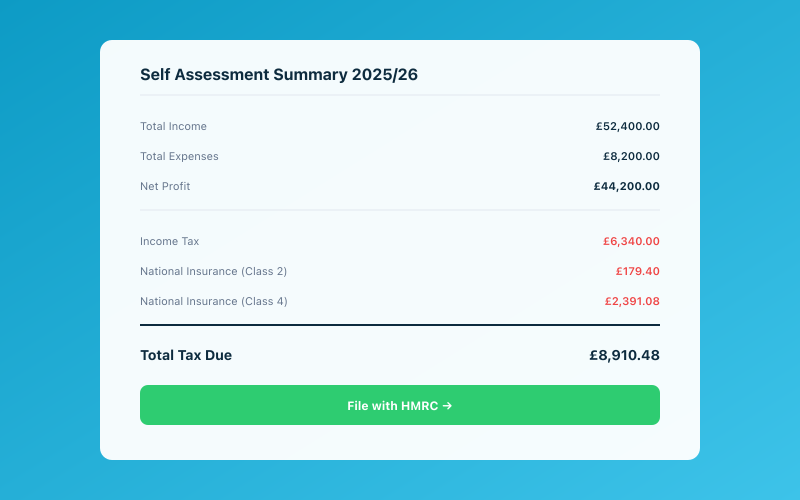 Your Accounted dashboard shows your real-time tax position
It allows your company to provide you (and your employees) with small benefits worth up to £50 each, completely free of tax and National Insurance. For directors, there is an annual cap of £300. This guide explains the rules, what qualifies, and how to make the most of it.
What Is a Trivial Benefit?
A trivial benefit is a small, non-cash benefit provided by an employer to an employee or director that meets all of the following conditions:
- The cost to the employer is £50 or less (including VAT).
- It is not cash or a cash voucher. A cash voucher is one that can be exchanged for cash.
- The employee is not entitled to it as part of a contractual arrangement — it must not be written into their employment contract or be a reward for particular services.
- It is not provided as part of a salary sacrifice arrangement.
If all four conditions are met, the benefit is exempt from Income Tax and National Insurance. The employer does not need to report it on a P11D, and the employee does not pay tax on it.
The £300 Annual Cap for Directors
For employees who are not directors (and not members of a director's family or household), there is no annual cap on the number of trivial benefits they can receive — each one just needs to be £50 or under.
For directors of close companies (companies controlled by five or fewer shareholders, which includes most small limited companies), there is an additional restriction: the total value of trivial benefits in the tax year must not exceed £300.
This means a director can receive up to six benefits of £50 each per tax year, for a total of £300 in tax-free perks. If the total exceeds £300, the excess becomes a taxable benefit.
Family members
If a director's spouse, civil partner, or family member is also an employee of the company, they have their own £300 annual cap. This effectively doubles the tax-free benefit if both are employees.
What Qualifies as a Trivial Benefit
Gift cards and vouchers
Non-cash vouchers that cannot be exchanged for cash are the most common form of trivial benefit. Examples include:
- Amazon gift cards (up to £50 each)
- High street gift cards (John Lewis, M&S, Sainsbury's)
- Restaurant gift cards
- Experience vouchers
The key distinction is that these vouchers cannot be converted back to cash. A Love2shop voucher that can only be spent at participating retailers qualifies. A voucher that can be cashed in at the post office does not.
Meals and entertainment
Taking your team (or yourself, as a director) for a meal costing £50 or less per person qualifies, provided it is not a contractual entitlement or a reward for performance. A birthday lunch, a pre-Christmas team meal, or a spontaneous "well done" dinner all work.
Small gifts
Flowers, a box of chocolates, a bottle of wine, or a small gift for a birthday, anniversary, or other personal occasion all qualify — as long as the cost is £50 or less.
Seasonal gifts
Christmas hampers, Easter eggs, and similar seasonal gifts costing £50 or less per person qualify. Many small companies use this to provide a Christmas gift to each director and employee without any tax liability.
Event tickets
Cinema tickets, theatre tickets, or sports event tickets costing £50 or less can qualify, provided they are not a reward for services.
What Does Not Qualify
Cash
Cash payments are never trivial benefits. Handing a director £50 in cash is taxable as earnings, regardless of the occasion.
Cash vouchers
Any voucher that can be exchanged for cash — even partially — does not qualify. Check the terms of the voucher carefully.
Contractual benefits
If a benefit is written into the employment contract (for example, "the company will provide a birthday gift each year"), it is a contractual entitlement and does not qualify for the trivial benefit exemption. Keep benefits spontaneous and discretionary.
Rewards for performance
A benefit given specifically as a reward for work done — "here is a £50 voucher for hitting your sales target" — is a reward for services and does not qualify. The benefit should not be linked to performance.
Benefits over £50
If a single benefit costs £50.01 or more, the entire amount is taxable — not just the excess over £50. The £50 threshold is absolute. A gift card for £51 is fully taxable as a benefit in kind.
This means you need to be careful about costs including VAT. If you buy a gift for £41.67 plus 20% VAT, the cost to the employer is £50 — that qualifies. If the pre-VAT price is £42, the total is £50.40, and the entire amount fails the test.
Salary sacrifice
Benefits provided through a salary sacrifice arrangement do not qualify. The employee must not give up any salary or bonus in exchange for the benefit.
Planning Your Trivial Benefits
For a director of a small limited company, the optimal approach is to use the full £300 annual allowance. Here is an example of how to spread it across the year:
| Month | Benefit | Cost | |-------|---------|------| | January | Amazon gift card (New Year) | £50 | | March | Restaurant gift card (end of tax year) | £50 | | May | Experience voucher (birthday) | £50 | | August | High street gift card (summer) | £50 | | October | Theatre tickets (autumn treat) | £50 | | December | Christmas hamper | £50 | | Total | | £300 |
This provides £300 of tax-free benefits across the year. If the director is a 40% taxpayer, the tax saving compared to taking the same amount as salary is approximately £134 (£300 x 40% income tax, plus employer's and employee's NI savings).
If both you and your spouse are directors, that is £600 in tax-free benefits per year.
Corporation Tax Deduction
The cost of providing trivial benefits is a deductible business expense for Corporation Tax purposes. Your company pays £300 for the benefits, deducts £300 from its profits, and saves Corporation Tax at 25% (or the marginal rate applicable to your company). That is an additional saving of up to £75.
Record Keeping
Even though trivial benefits are exempt from P11D reporting, you should still keep records. HMRC can enquire into your trivial benefit claims, and you need to demonstrate that each benefit met all four qualifying conditions.
For each benefit, record:
- The date it was provided
- A description of the benefit
- The cost (including VAT)
- The recipient
- The reason it was given (birthday, Christmas, spontaneous gesture)
Keep receipts or invoices for all purchases. A simple spreadsheet tracking your trivial benefits across the year is sufficient.
Common Mistakes to Avoid
- Going over £50 per benefit. Double-check costs including VAT. Even £0.01 over the threshold disqualifies the entire benefit.
- Exceeding the £300 annual cap. Track the running total across the tax year for each director.
- Using cash or cash-convertible vouchers. Always check the voucher terms.
- Making benefits contractual. Do not include trivial benefits in employment contracts, staff handbooks, or bonus schemes.
- Linking benefits to performance. Keep the benefit separate from any work targets or achievements.
- Forgetting to record the benefit. No records means no evidence if HMRC asks.
Combining With Other Tax-Efficient Extraction
Trivial benefits work best as part of a broader tax-efficient strategy for owner-directors:
- Salary up to the NI primary threshold (£12,570 for 2025/26) — tax-free and preserves State Pension entitlement
- Dividends up to the basic rate band — taxed at 8.75%
- Employer pension contributions — Corporation Tax deductible, no NI, no Income Tax (within annual allowance)
- Trivial benefits — £300 per director, completely tax-free
- Annual events exemption — up to £150 per head for staff parties (separate from trivial benefits)
Together, these form a tax-efficient package that minimises the total tax and NI paid on money extracted from the company.
How Accounted Tracks Your Benefits
It is easy to lose track of trivial benefits across the year, especially when you are focused on running your business. Accounted tracks your trivial benefit spending automatically — Penny, the AI bookkeeper, identifies qualifying purchases, monitors your running total against the £300 cap, and flags when you are approaching the limit. No more guesswork, no more spreadsheets.
Start Your Free Trial With Accounted
Every tax-free pound counts when you are running a small company. Accounted helps you make the most of trivial benefits and other tax-efficient strategies. Start your free trial today and let Penny keep track of every perk.
Related Reading
-
Salary vs Dividends 2025/26: The Most Tax-Efficient Way to Pay Yourself
-
Corporation Tax Rates 2025/26: What Small Companies Need to Know
Start your free trial and let Penny handle your bookkeeping automatically.
Penny, your AI bookkeeper, tracks your tax position in real time and flags opportunities to reduce your bill. Meet Penny →
Tax & Compliance Specialists
Our tax specialists have decades of combined experience in UK sole trader and small business taxation, MTD compliance, and HMRC submissions. All content is reviewed against current HMRC guidance before publication and updated quarterly to reflect legislative changes.
Ready to try Accounted?
Join UK sole traders who are simplifying their bookkeeping and tax.
Start your 14-day free trial