Corporation Tax Rates 2025/26: What Small Companies Need to Know
The Two Corporation Tax Rates
Since April 2023, the UK has operated a two-tier Corporation Tax system. Gone are the days of a single flat rate for all companies. For the 2025/26 financial year (1 April 2025 to 31 March 2026), the rates are:
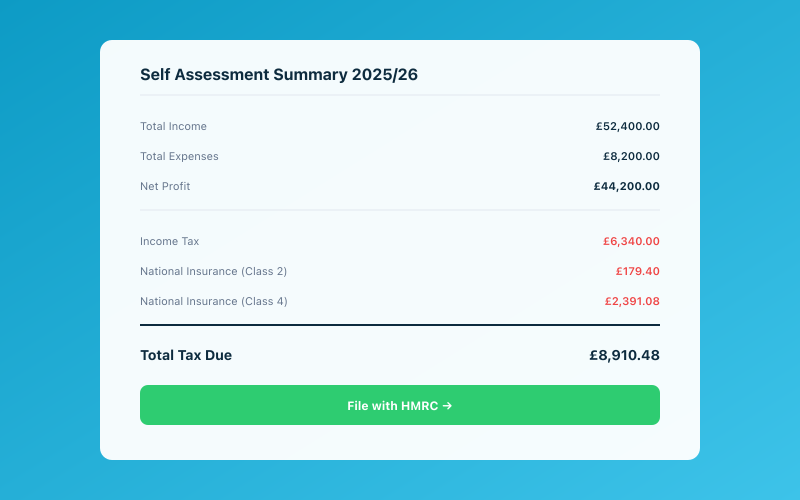 Your Accounted dashboard shows your real-time tax position
- Small profits rate: 19% — for companies with taxable profits of £50,000 or less
- Main rate: 25% — for companies with taxable profits of £250,000 or more
If your profits fall between £50,000 and £250,000, you're in the marginal relief band, and the effective rate gradually increases from 19% towards 25%. This is where it gets interesting — and where most small limited companies sit.
How Marginal Relief Works
Marginal relief is designed to smooth the transition between the two rates so that earning £50,001 doesn't suddenly cost you thousands more in tax than earning £50,000. Without it, there would be a "cliff edge" that punished companies for growing.
The Formula
The marginal relief formula is:
Marginal Relief = (Upper Limit – Profits) × Profits/Profits × Fraction
The fraction for 2025/26 is 3/200 (or 1.5%).
In practice, the effective tax rate in the marginal band starts at 19% on profits of £50,000 and gradually rises to 25% at £250,000. Within the band itself, the marginal rate on each additional pound of profit is actually 26.5% — higher than the main rate. This is the mathematical consequence of smoothing the transition.
A Worked Example
Let's say your company has taxable profits of £100,000 for the year ending 31 March 2026.
Step 1: Calculate tax at the main rate £100,000 × 25% = £25,000
Step 2: Calculate marginal relief (£250,000 – £100,000) × (£100,000 / £100,000) × 3/200 = £150,000 × 1 × 0.015 = £2,250
Step 3: Deduct marginal relief from the main rate tax £25,000 – £2,250 = £22,750
Effective rate: £22,750 / £100,000 = 22.75%
So on £100,000 of profit, you pay £22,750 in Corporation Tax — not the full 25% (£25,000), but more than 19% (£19,000). The marginal relief saves you £2,250.
Quick Reference: Effective Rates
Here's a snapshot of effective Corporation Tax rates at various profit levels:
| Taxable Profits | Tax Payable | Effective Rate | |-----------------|-------------|----------------| | £50,000 | £9,500 | 19.00% | | £75,000 | £15,188 | 20.25% | | £100,000 | £22,750 | 22.75% | | £150,000 | £37,875 | 25.25%* | | £200,000 | £47,250 | 23.63% | | £250,000 | £62,500 | 25.00% |
*The effective rate exceeds 25% at certain points within the band because the 26.5% marginal rate applies to profits within the band, while the blended rate includes the 19% on the first £50,000. The overall effective rate reaches 25% at the upper limit.
Associated Companies: The Hidden Complication
Here's the part that catches many directors off guard. The £50,000 and £250,000 thresholds are divided equally among associated companies.
Two companies are associated if one controls the other, or if both are under common control. In practical terms, if you're a director who controls two limited companies, both are associated.
How It Affects the Thresholds
If you have two associated companies, the limits are halved:
- Small profits rate applies up to £25,000 per company (not £50,000)
- Main rate applies from £125,000 per company (not £250,000)
Three associated companies? The limits are divided by three: £16,667 and £83,333.
This means a consultant running two limited companies could find themselves paying the main rate on profits that would otherwise qualify for the small profits rate. It's worth considering whether multiple companies genuinely serve separate business purposes or whether consolidation would be more tax-efficient.
Dormant Companies
Dormant companies generally don't count as associated for these purposes, provided they genuinely haven't traded during the accounting period. But a company that earned even a small amount of interest on its bank balance technically isn't dormant. Check carefully.
Payment Deadlines
Corporation Tax is due nine months and one day after the end of your accounting period. For a company with a year-end of 31 March 2026, that means payment is due by 1 January 2027.
File your Company Tax Return (CT600) within twelve months of the accounting period end — so by 31 March 2027 for a March 2026 year-end.
Large Companies: Quarterly Instalments
If your company's taxable profits exceed £1.5 million (divided by associated companies), you'll need to pay Corporation Tax in four quarterly instalments during the accounting period itself, rather than nine months after. Most small companies won't hit this threshold, but it's worth knowing if you're growing rapidly.
Penalties for Late Filing and Payment
- Late filing: £100 penalty if up to 3 months late, £200 if more than 3 months late, plus 10% of unpaid tax if 6 months late, and a further 10% if 12 months late
- Late payment: Interest accrues from the due date at the Bank of England base rate plus 2.5%
Practical Strategies for Small Companies
Salary vs Dividends
The interplay between Corporation Tax and personal tax makes the salary-versus-dividends decision crucial. Paying yourself a salary reduces Corporation Tax profits but triggers employer's National Insurance. Paying dividends doesn't reduce your Corporation Tax bill but is taxed at lower personal rates. Our guide on dividends vs salary works through the optimal approach.
Timing of Expenses
If your profits are near the £50,000 threshold, bringing forward legitimate expenses — purchasing equipment, paying for training, or making pension contributions — could keep you in the small profits rate band and save you a meaningful amount.
Pension Contributions
Employer pension contributions are a Corporation Tax deductible expense and don't trigger National Insurance. For directors looking to extract profits tax-efficiently, maximising pension contributions (up to the annual allowance of £60,000) can be one of the most effective strategies available.
Research and Development Tax Relief
If your company spends money on qualifying R&D activities, you may be able to claim enhanced deductions or tax credits. The rules have changed significantly in recent years, so check the current scheme — but for eligible companies, R&D relief can substantially reduce your effective tax rate.
Tracking Your Corporation Tax with Accounted
Managing Corporation Tax effectively requires accurate, up-to-date profit figures throughout the year — not just at year-end. Accounted's Corporation Tax features track your running profit position, estimate your tax liability in real time, and ensure you're never surprised by your bill.
Get Started with Accounted
Whether you're a sole director or running multiple companies, Accounted keeps your Corporation Tax under control. Real-time profit tracking, automatic expense categorisation, and clear tax estimates throughout the year. Start your free trial today — no credit card required.
Related Reading
Penny, your AI bookkeeper, tracks your tax position in real time and flags opportunities to reduce your bill. Meet Penny →
Tax & Compliance Specialists
Our tax specialists have decades of combined experience in UK sole trader and small business taxation, MTD compliance, and HMRC submissions. All content is reviewed against current HMRC guidance before publication and updated quarterly to reflect legislative changes.
Ready to try Accounted?
Join UK sole traders who are simplifying their bookkeeping and tax.
Start your 14-day free trial