Furnished Holiday Let Rules 2026: What's Changing for Landlords
What Is a Furnished Holiday Let?
A Furnished Holiday Let (FHL) is a specific category of rental property that has historically enjoyed significant tax advantages over standard buy-to-let properties. To qualify as an FHL, a property must meet strict conditions around availability and actual letting — it's not enough to simply rent out a furnished holiday cottage occasionally.
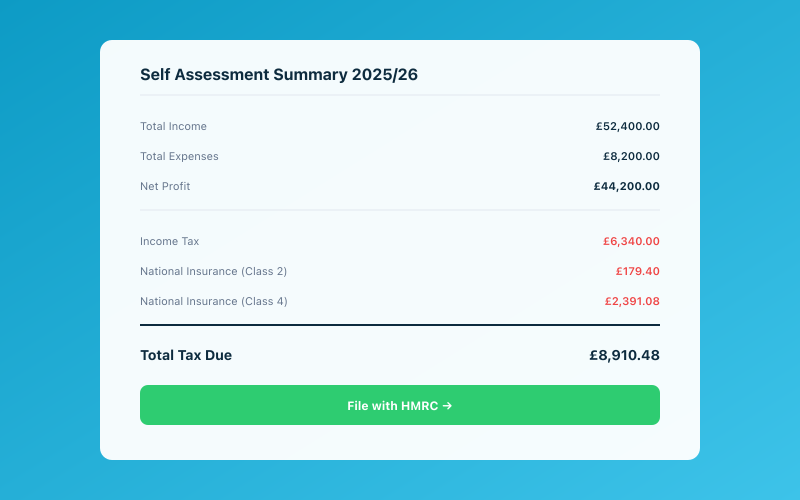 Your Accounted dashboard shows your real-time tax position
For decades, FHL status has allowed landlords to access tax reliefs that are otherwise reserved for trading businesses. That's about to change.
The Qualifying Conditions
To qualify as an FHL in the UK, a property must meet three conditions in each tax year:
1. The Availability Condition — 210 Days
The property must be available for commercial letting to the public for at least 210 days per year. "Available" means genuinely marketed and ready for guests — not simply theoretically available while you use it yourself.
2. The Letting Condition — 105 Days
The property must actually be commercially let for at least 105 days per year. This means real bookings from paying guests. Periods where you let the property to friends or family at a reduced rate (or free) generally don't count unless they pay a genuine market rent.
3. The Pattern of Occupation Condition
No single letting to the same person can exceed 31 consecutive days, and such longer lets must not total more than 155 days in the year. This prevents landlords from reclassifying a standard long-term let as an FHL.
The Averaging Election
If you own multiple FHL properties and some don't meet the 105-day letting condition individually, you can make an averaging election. This lets you average the letting days across all your FHL properties. So if Property A was let for 140 days and Property B was let for 70 days, the average is 105 days — and both qualify.
The Grace Period Election
If a property met the conditions in the previous year but falls short this year (perhaps due to a renovation period or a slow season), you can make a grace period election for up to two consecutive years, treating the property as if it still qualifies.
The Tax Advantages of FHL Status (Until Now)
FHL properties have been treated as a trading activity for several important tax purposes, giving them advantages that standard residential lettings don't receive:
Capital Allowances
FHL owners can claim capital allowances on furniture, fixtures, and equipment — the same reliefs available to any trading business. This includes the Annual Investment Allowance, allowing the full cost of qualifying items to be deducted in the year of purchase, up to £1 million.
Standard residential landlords lost the wear and tear allowance in 2016 and can only claim replacement relief (deducting the cost of replacing, not the original purchase of, furnishings).
Capital Gains Tax Reliefs
FHL properties qualify for several CGT reliefs:
- Business Asset Disposal Relief (BADR): A 10% CGT rate on the first £1 million of qualifying gains, instead of the standard 18%/24% rates for residential property
- Rollover Relief: Defer CGT by reinvesting sale proceeds into another qualifying business asset
- Gift Relief (Holdover Relief): Transfer the property without triggering an immediate CGT charge
Pension Contributions
FHL profits count as relevant UK earnings for pension contribution purposes. This means FHL income can support higher pension contributions — particularly valuable for landlords whose only other income is from non-trading sources.
Loss Relief
Losses from an FHL business can be carried forward and set against future FHL profits. Under the old rules, FHL losses could also be offset more flexibly than standard property losses.
Mortgage Interest Deduction
Perhaps most significantly, FHL properties have been exempt from Section 24 — the restriction on mortgage interest relief that has hit standard buy-to-let landlords hard since 2020. FHL owners could deduct their full mortgage interest as a business expense, just as any trading business can.
What's Changing from April 2025
The government announced in the Autumn Budget 2024 that the FHL tax regime will be abolished from 6 April 2025. This means:
Capital Allowances — Gone
FHL properties will no longer qualify for capital allowances on furniture and equipment. Instead, FHL landlords will be limited to the same replacement relief available to standard residential landlords — you can only deduct the cost of replacing an item, not the original purchase.
If you've been planning a major furnishing or equipment purchase for your FHL property, doing it before 6 April 2025 would allow you to claim capital allowances under the current rules.
Capital Gains Tax Reliefs — Gone
Business Asset Disposal Relief, Rollover Relief, and Gift Relief will no longer apply to FHL properties. When you sell, you'll pay CGT at the standard residential property rates:
- 18% for basic-rate taxpayers
- 24% for higher-rate taxpayers
For a landlord with a £200,000 gain who would have qualified for BADR at 10%, the change means paying £48,000 instead of £20,000 in CGT. That's a substantial difference.
Pension Contributions — Restricted
FHL income will no longer count as relevant UK earnings. If your FHL rental income was the basis for making pension contributions, you'll be limited to the £3,600 gross contribution available to non-earners (unless you have other earned income).
Mortgage Interest — Section 24 Applies
FHL properties will fall under the same Section 24 restrictions as standard buy-to-lets. Instead of deducting mortgage interest from rental profits, you'll receive a 20% tax credit. For higher-rate taxpayers, this is a significant hit.
Loss Relief — Restricted
FHL losses will be treated the same as standard property losses — offsettable only against future property income, not more broadly.
What About Properties Already Qualifying as FHL?
There's no grandfathering or transitional relief. From 6 April 2025, the FHL regime simply ceases to exist. Properties that qualified as FHL on 5 April 2025 are treated as standard residential lettings from 6 April 2025 onwards.
Any capital allowances already claimed are not clawed back — you keep the benefit of past claims. But no further claims can be made under the FHL rules.
For Capital Gains Tax, the base cost of your property doesn't change. But when you eventually sell, the gain will be taxed at residential property rates, not the BADR rate you might have been planning for.
What Landlords Should Do Now
Review Your Numbers
Run the figures for your FHL property under the new rules. How does the loss of capital allowances, Section 24 exemption, and CGT reliefs affect your position? For some landlords, the property will still be profitable. For others, the changes may tip the balance.
Consider Selling Before the Changes Bite
If you were planning to sell an FHL property in the next few years, selling before 6 April 2025 would allow you to claim BADR at 10% on the gain. After that date, you'll pay 18% or 24%.
However, rushing a sale purely for tax reasons isn't always wise. The property market, your personal circumstances, and the size of the potential gain all factor in.
Consider Incorporation
Transferring FHL properties into a limited company preserves the ability to deduct mortgage interest in full against Corporation Tax (avoiding Section 24). The same considerations apply as for standard buy-to-let incorporation — SDLT costs, potential CGT, mortgage refinancing, and ongoing company administration.
Maximise Capital Allowances Now
If you have planned expenditure on furniture, fixtures, or equipment for your FHL property, bringing it forward to before 6 April 2025 allows you to claim capital allowances under the existing rules. After that date, you'll only get replacement relief.
Adjust Your Pension Strategy
If your FHL income supported significant pension contributions, you'll need alternative earned income to maintain those contribution levels. Consider whether drawing a salary from a company or increasing other self-employment activities could fill the gap.
Tracking Property Income with Accounted
Whether your property is a former FHL or a standard residential let, Accounted's property tracking features help you stay on top of your rental finances. Income, expenses, mortgage interest, and tax position — all in one place, updated in real time.
Get Started with Accounted
The FHL changes make accurate property accounting more important than ever. Accounted helps landlords track every aspect of their rental income and understand their true tax position after the rule changes. Start your free trial today — no credit card required.
Related Reading
Penny, your AI bookkeeper, tracks your tax position in real time and flags opportunities to reduce your bill. Meet Penny →
Tax & Compliance Specialists
Our tax specialists have decades of combined experience in UK sole trader and small business taxation, MTD compliance, and HMRC submissions. All content is reviewed against current HMRC guidance before publication and updated quarterly to reflect legislative changes.
Ready to try Accounted?
Join UK sole traders who are simplifying their bookkeeping and tax.
Start your 14-day free trial