The Pension Annual Allowance: What Happens If You Exceed £60,000?
The pension annual allowance for 2025/26 is £60,000. Go over it — whether by accident or poor planning — and HMRC charges you tax on the excess. For high earners, the allowance can be lower still. And if you have already started taking money from a pension, there is yet another, much smaller, limit to worry about. This guide explains what happens if you exceed the annual allowance and how to avoid or handle the charge.
What Is the Annual Allowance?
The annual allowance is the maximum amount of pension savings that benefit from tax relief in a single tax year. For 2025/26, the standard annual allowance is £60,000.
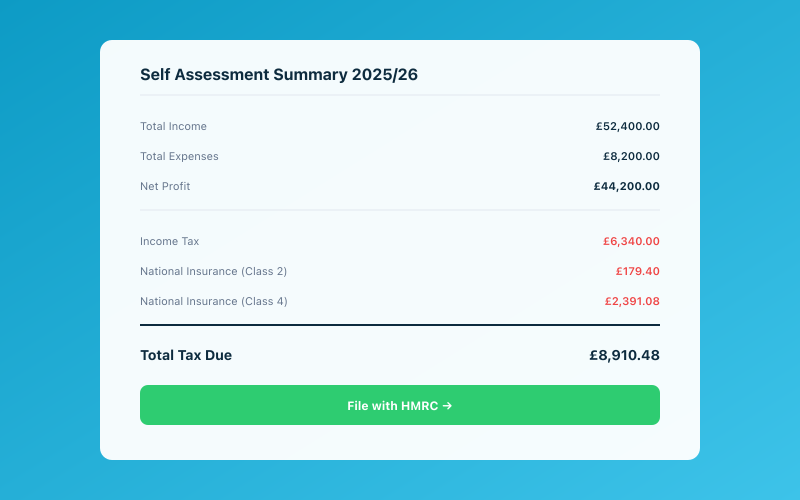 Your Accounted dashboard shows your real-time tax position
This covers all pension contributions from all sources: your personal contributions (including tax relief), any employer contributions, and any contributions made on your behalf. If you have multiple pensions — say a workplace scheme and a SIPP — the contributions to all of them count towards the same £60,000 limit.
For defined benefit (final salary) schemes, the calculation is different. Instead of actual contributions, HMRC uses the increase in the value of your benefits during the year, calculated using a formula. This can produce surprising numbers, especially if you get a pay rise or promotion.
What Is the Annual Allowance Charge?
If your total pension inputs in a tax year exceed the annual allowance (after any carry forward), you pay the annual allowance charge on the excess. This is not a penalty — it is a tax charge designed to claw back the tax relief you received on contributions above the limit.
The charge is calculated at your highest marginal rate of Income Tax. So if you are a higher rate taxpayer, you pay 40% on the excess. If you are an additional rate taxpayer, you pay 45%.
Example
You have a standard annual allowance of £60,000. Your total pension contributions in 2025/26 (including employer contributions and tax relief) are £75,000. You have no carry forward available.
Excess: £75,000 minus £60,000 = £15,000.
If you are a 40% taxpayer, the annual allowance charge is: £15,000 x 40% = £6,000.
This charge is added to your Self Assessment tax bill. You report it on your tax return, and HMRC collects it along with your other taxes.
The Tapered Annual Allowance
If you are a high earner, your annual allowance may be less than £60,000. This is called the tapered annual allowance, and it catches people who earn more than £260,000 (including pension contributions).
How it works
Two income figures matter:
Threshold income: Your taxable income before pension contributions. If this is £200,000 or less, the taper does not apply to you regardless of your total income. You get the full £60,000 allowance.
Adjusted income: Your taxable income plus pension contributions (including employer contributions). If this exceeds £260,000, your annual allowance starts to reduce.
The reduction is £1 for every £2 of adjusted income above £260,000. The minimum tapered annual allowance is £10,000, which applies once adjusted income reaches £360,000.
Example
Your threshold income is £220,000 (above £200,000, so the taper can apply). Your employer contributes £30,000 to your pension. Your adjusted income is £250,000 + £30,000 = £280,000.
Adjusted income exceeds £260,000 by £20,000. Your allowance is reduced by £10,000 (half of £20,000).
Your tapered annual allowance: £60,000 minus £10,000 = £50,000.
If total pension contributions (including the employer's £30,000) exceed £50,000, you face the annual allowance charge on the excess.
Why this matters for self-employed people
The tapered annual allowance mainly affects people with very high earnings. But if you are a successful consultant, contractor, or business owner with profits above £200,000, you need to check whether the taper applies before making large pension contributions. Getting it wrong could mean an unexpected tax charge.
The Money Purchase Annual Allowance (MPAA)
There is a third, much lower, limit that catches some people off guard. If you have flexibly accessed a defined contribution pension — meaning you have taken taxable income from it (not just the 25% tax-free lump sum) — your annual allowance for future money purchase contributions drops to just £10,000.
This is the money purchase annual allowance (MPAA), introduced to stop people recycling pension funds.
What triggers the MPAA
The MPAA applies once you take taxable income from a defined contribution pension — for example through flexi-access drawdown or an uncrystallised funds pension lump sum. It does not apply if you only take your 25% tax-free cash and leave the rest invested, or if you buy a traditional level annuity.
Why this matters
If you are self-employed and have drawn on a pension during a quiet period, you may have triggered the MPAA without realising it — limiting future SIPP contributions to £10,000 per year. You also lose the ability to carry forward unused allowance for money purchase contributions.
How the Annual Allowance Charge Is Calculated
The charge is added to your Income Tax liability for the year. It is calculated at your marginal rate, which means it depends on your other income.
Step by step
- Work out your total pension input amount for the year (all contributions from all sources, including tax relief).
- Subtract your available annual allowance (including any carry forward from the previous three years).
- The result is the excess amount.
- The excess is taxed at your marginal Income Tax rate.
Interaction with tax bands
The excess is treated as the top slice of your income. So if your taxable income (before the pension excess) puts you in the higher rate band, the excess is taxed at 40%. If part of the excess falls in the additional rate band (above £125,140), that part is taxed at 45%.
Example with band interaction
Your taxable income before the excess is £120,000. You have an annual allowance excess of £20,000.
- £5,140 of the excess falls in the higher rate band (£120,000 to £125,140): taxed at 40% = £2,056
- £14,860 of the excess falls in the additional rate band (above £125,140): taxed at 45% = £6,687
- Total charge: £8,743
Scheme Pays
If your annual allowance charge is more than £2,000 and the excess contributions came from a single pension scheme, you can ask that scheme to pay the charge on your behalf. This is called mandatory scheme pays.
The scheme pays the charge to HMRC and reduces your pension benefits accordingly. You end up with a smaller pension, but you do not have to find the cash to pay the charge now.
Deadlines
You must tell the scheme you want to use scheme pays by 31 July following the end of the tax year. For excess contributions in 2025/26, the deadline is 31 July 2027.
There is also voluntary scheme pays, where the scheme agrees to pay even if the mandatory conditions are not met. This is at the scheme's discretion.
Is scheme pays a good idea?
It reduces your pension pot, but avoids finding the cash now. For large charges, it can make practical sense.
How to Report the Charge
You report the annual allowance charge on your Self Assessment tax return in the pension section. Even if your provider has processed scheme pays, you still need to report the excess. HMRC needs the full picture.
How to Avoid Exceeding the Allowance
Track contributions throughout the year
Do not wait until the end of the tax year to check. Keep a running total of all pension contributions from all sources — personal, employer, and tax relief. If you have multiple pensions, add them all together.
Check carry forward availability
Before making a large contribution, calculate your available carry forward from the previous three years. This could significantly increase your effective allowance.
Watch employer contributions
If you are also employed, employer pension contributions count towards your annual allowance. A generous employer scheme combined with personal SIPP contributions can push you over the limit.
Be careful with defined benefit accrual
In defined benefit schemes, the pension input amount uses a formula, not actual contributions. A pay rise can cause a large spike you might not anticipate.
Get advice for complex situations
If you are near the tapered allowance thresholds, have triggered the MPAA, or have both defined benefit and defined contribution pensions, professional advice is worth the cost.
Stay on Top of Your Numbers with Accounted
Knowing your precise self-employed profit is essential for pension planning. If you are making contributions based on estimated income and get it wrong, an annual allowance charge could wipe out the tax benefit. Accounted keeps your income and expenses up to date so you always know where you stand. Penny, the AI bookkeeper, helps you stay organised throughout the year, not just at Self Assessment time.
Start your free trial of Accounted today and take the uncertainty out of your tax and pension planning.
Related Reading
-
Carry Forward Pension Allowances: Use Previous Years' Unused Allowance
-
Can I Claim Clothing as a Business Expense? HMRC Rules Explained
Start your free trial and let Penny handle your bookkeeping automatically.
Penny, your AI bookkeeper, tracks your tax position in real time and flags opportunities to reduce your bill. Meet Penny →
Tax & Compliance Specialists
Our tax specialists have decades of combined experience in UK sole trader and small business taxation, MTD compliance, and HMRC submissions. All content is reviewed against current HMRC guidance before publication and updated quarterly to reflect legislative changes.
Ready to try Accounted?
Join UK sole traders who are simplifying their bookkeeping and tax.
Start your 14-day free trial