Overlap Relief — Claiming Back Tax You've Overpaid
The Tax That Gets Charged Twice
There is a peculiar quirk in the UK tax system that has caught out sole traders for decades. When you first start trading, the way your profits are allocated to tax years can mean that some of your profits are effectively taxed twice. These doubly-taxed profits are called "overlap profits," and the mechanism to get that tax back is called "overlap relief."
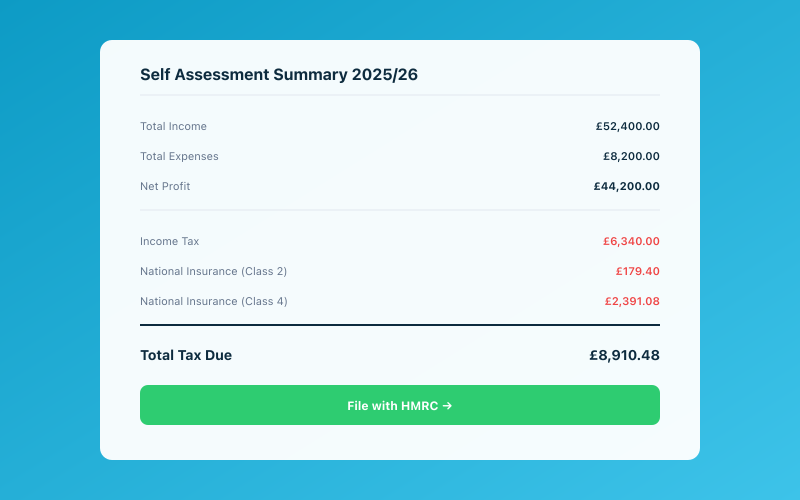 Your Accounted dashboard shows your real-time tax position
If you have never heard of overlap relief, you are not alone. It is one of the least understood areas of Self Assessment, and many sole traders have overlap profits sitting unclaimed because they simply did not know they existed.
The good news? The basis period reform that took effect from April 2024 has fundamentally changed how this works going forward. But overlap relief is still relevant — particularly if you are ceasing trade, changing your accounting date, or dealing with the transitional provisions from 2023/24.
How Overlap Profits Arise
To understand overlap profits, you need to understand how the old basis period rules worked.
The Old Basis Period Rules
Under the traditional system, your profits for a tax year were based on your accounting period ending in that tax year. So if your accounting year ended on 30 June 2022, those profits would be taxed in the 2022/23 tax year (because 30 June 2022 falls within the 6 April 2022 to 5 April 2023 tax year).
Simple enough. But in your first years of trading, things got complicated.
Year One — The Actual Basis
In your first tax year of trading, you were taxed on your actual profits from the date you started to the following 5 April. If you started on 1 October 2020, you were taxed on profits from 1 October 2020 to 5 April 2021 (roughly six months).
Year Two — The 12-Month Rule
In your second tax year, if you had a 12-month accounting period ending in that year, you were taxed on those 12 months. If your year end was 30 September, you would be taxed on the 12 months to 30 September 2021.
But notice the overlap: the period from 1 October 2020 to 5 April 2021 was already taxed in Year One. And the period from 1 October 2020 to 30 September 2021 is being taxed in Year Two. That six-month period has been taxed twice.
The Overlap Period
Those doubly-taxed profits — in this example, the profits from 1 October 2020 to 5 April 2021 — are your overlap profits. You have effectively paid tax on them twice, and HMRC owes you relief for that double taxation.
A Worked Example
Suppose Sarah starts trading on 1 July 2019 and has a 30 June accounting year end. Her first set of accounts covers 1 July 2019 to 30 June 2020, showing a profit of £24,000 (£2,000 per month).
Tax year 2019/20 (6 April 2019 to 5 April 2020): Taxed on actual profits from 1 July 2019 to 5 April 2020 = 9 months = £18,000
Tax year 2020/21 (6 April 2020 to 5 April 2021): Taxed on 12 months to 30 June 2020 = £24,000
The period from 1 July 2019 to 5 April 2020 (9 months, £18,000) has been taxed in both years. Sarah's overlap profits are £18,000.
When to Claim Overlap Relief
Historically, there were two main situations where you could claim overlap relief:
On Cessation of Trade
When you stop trading, you claim your overlap relief against your final year's profits. This was the most common way overlap relief was used. If Sarah closes her business in 2025 with final year profits of £30,000 and overlap profits of £18,000, she would only be taxed on £12,000 for that final year.
On Change of Accounting Date
If you changed your accounting date to bring your year end closer to 5 April (or to 31 March, which HMRC treats as equivalent), you could claim a proportionate amount of overlap relief. This was the only way to access overlap relief without actually stopping your business.
The Basis Period Reform — A Game Changer
From the 2024/25 tax year onwards, the basis period rules have been abolished. All sole traders are now taxed on the profits arising in the tax year itself (6 April to 5 April), regardless of their accounting date.
This means overlap profits can no longer arise for new businesses starting from April 2024 onwards. The system that created the problem has been fixed.
The 2023/24 Transitional Year
The 2023/24 tax year was the transitional year. Here is what happened:
- Sole traders with accounting dates other than 31 March or 5 April were taxed on their profits from the end of their accounting period in 2022/23 to 5 April 2024
- This created "transitional profits" — the extra profits arising from the longer-than-usual basis period
- Overlap relief was automatically deducted from these transitional profits
- Any remaining transitional profits (after deducting overlap relief) can be spread over five tax years (2023/24 to 2027/28) to ease the cash flow impact
Example of the Transition
Using Sarah's example with a 30 June year end and £18,000 of overlap profits:
2023/24 transitional year basis period: 1 July 2022 to 5 April 2024 (21 months)
If her profits were £2,000/month, the total for 21 months would be £42,000. Deducting her £18,000 overlap relief leaves transitional profits of £24,000. She would normally be taxed on 12 months (£24,000 standard) plus the £24,000 transitional amount, but the transitional profits can be spread:
- £4,800 per year over the five years 2023/24 to 2027/28
This spreading mechanism prevents a sudden, large tax bill in the transitional year.
What If You Do Not Know Your Overlap Figure?
This is a common problem. Many sole traders — and even some accountants — did not keep proper records of overlap profits from the early years of trading.
Check Your Records
Look at your tax returns from your first years of trading. The overlap figure should be noted on the Self Employment pages (SA103). It may also be in correspondence from your accountant at the time.
Ask HMRC
HMRC should have records of your overlap profits. You can write to them or call the Self Assessment helpline to request the information. Be prepared for this to take some time — HMRC's records from many years ago are not always easily accessible.
Reconstruct the Figures
If no records exist, you may need to reconstruct the calculation from your original accounts. This requires your profit figures from your first accounting period and knowledge of your original accounting date. An accountant can help with this if the records are available.
The Default Assumption
If you genuinely cannot establish your overlap profits and HMRC cannot help, the default position is zero overlap relief. This is why keeping proper records from day one is so important — Penny, the AI bookkeeper within Accounted, makes this effortless by maintaining complete, searchable records from the moment you start using the platform.
How to Include Overlap Relief on Your Tax Return
When claiming overlap relief (typically on cessation or during the 2023/24 transition), you include it on the Self Employment pages (SA103) of your Self Assessment return:
- Box 65 on the SA103 is for overlap profits brought forward
- Box 66 is for overlap profits used in the current year
- Box 67 is for overlap profits carried forward (if you are only using part of them)
Your tax software or accountant will handle the mechanics, but you need to know the figure to report. With MTD, these details will be captured as part of your digital record-keeping and final declaration.
Does Overlap Relief Still Matter?
Yes, for three groups of people:
Sole Traders Who Are Ceasing Trade
If you started trading before April 2024 and have overlap profits that were not fully used during the 2023/24 transition, you can still claim them when you stop trading.
Sole Traders in the Transitional Spreading Period
If you had transitional profits in 2023/24 that are being spread over five years, you are living with the legacy of the overlap system right now. The spreading continues until 2027/28.
Anyone Checking Historical Returns
If you are reviewing old tax returns or dealing with an HMRC enquiry into past years, understanding overlap relief is necessary to verify that your historical tax position was calculated correctly.
The Positive Outcome of Reform
The basis period reform was overdue. The old system was confusing, created a hidden tax liability that many sole traders did not understand, and penalised people for choosing accounting dates that did not align with the tax year.
Going forward, the system is much simpler. Your tax year is the tax year. Your profits from 6 April to 5 April are what you are taxed on. No overlap, no basis period confusion, no hidden double taxation.
If you are starting a new business now, you never need to worry about overlap profits. And if you are an existing sole trader, the transitional year has dealt with your historical overlap — though you should verify that the figures were correct.
Keeping Clean Records
Whether you are dealing with transitional provisions or simply want to ensure your tax position is accurate going forward, clean financial records are your best protection. Accounted makes this straightforward with automated transaction categorisation and clear profit tracking, so you always know exactly what your taxable position is — no nasty surprises, no missing figures, and no need to reconstruct records years after the fact.
Related reading
- Self Assessment Tax Return — Your Complete Guide
- Making Tax Digital — Your Complete 2026 Guide
- Cash Basis vs Accrual Accounting
Related Reading
- Penalties for Late Self Assessment — The Complete Scale
- HMRC Compliance Checks vs Full Investigations — The Difference
Start your free trial and let Penny handle your bookkeeping automatically.
Accounted files your Self Assessment directly to HMRC, with your return pre-populated from your records. See Self Assessment filing →
Tax & Compliance Specialists
Our tax specialists have decades of combined experience in UK sole trader and small business taxation, MTD compliance, and HMRC submissions. All content is reviewed against current HMRC guidance before publication and updated quarterly to reflect legislative changes.
Ready to try Accounted?
Join UK sole traders who are simplifying their bookkeeping and tax.
Start your 14-day free trial