Penalties for Late Self Assessment — The Complete Scale
Missing a Self Assessment deadline is easier than you'd think. Life gets busy, January creeps up, and suddenly you've blown past the 31st without filing. The trouble is, HMRC doesn't care how busy you were — the penalties start stacking up straight away, and they can get surprisingly steep if you leave things too long.
Whether you've already missed the deadline or you're cutting it fine, here's exactly what you need to know about the penalty scale for late Self Assessment filing and late payment.
The Key Deadlines
Before we get into penalties, let's be clear about the deadlines themselves:
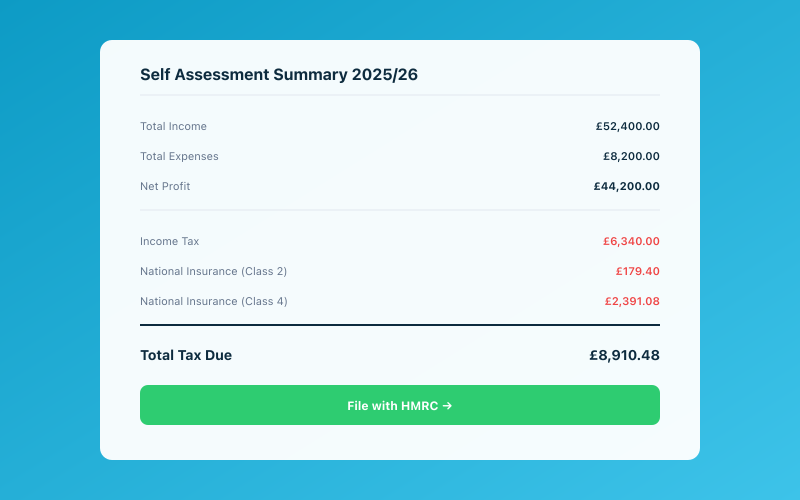 Your Accounted dashboard shows your real-time tax position
Paper returns: 31 October following the end of the tax year. So for the 2025/26 tax year (which ends 5 April 2026), your paper return must reach HMRC by 31 October 2026.
Online returns: 31 January following the end of the tax year. For 2025/26, that's 31 January 2027.
Payment of tax owed: Also 31 January. Your tax bill for the year must be paid by the same date as your online filing deadline.
Payments on account: If you owe more than £1,000 in tax, HMRC will require you to make payments on account — advance payments towards the following year's bill. These are due on 31 January and 31 July. For more on how these work, see our guide on how to pay your Self Assessment bill.
Now, let's look at what happens when you miss these deadlines.
Late Filing Penalties
The penalties for filing your Self Assessment return late follow a clear escalating scale:
One day late: £100 fixed penalty. This applies even if you owe no tax at all, or if you've already paid everything you owe. It's simply a penalty for not filing on time. Miss 31 January by a single day and you'll owe £100.
Three months late (1 May): Daily penalties of £10 per day. After three months, HMRC adds £10 for every day the return is outstanding, up to a maximum of ninety days. That's an additional £900 on top of the initial £100.
Six months late (1 August): Further penalty of 5% of the tax due, or £300, whichever is greater. So if you owe £4,000 in tax, the six-month penalty would be £200 (5% of £4,000) — but because £300 is the minimum, you'd actually pay £300. If you owed £10,000, the penalty would be £500.
Twelve months late (1 February the following year): Another 5% of the tax due, or £300, whichever is greater. In serious cases where HMRC considers the failure to be deliberate, this can increase to 100% of the tax due.
Let's add that up with an example. Say you owe £5,000 in tax and file your return twelve months late:
- Initial penalty: £100
- Daily penalties (90 days): £900
- Six-month penalty (5% of £5,000): £300 (minimum £300 applies)
- Twelve-month penalty (5% of £5,000): £300 (minimum £300 applies)
- Total penalties: £1,600
And that's before we even look at late payment penalties and interest.
Late Payment Penalties
Separate from the filing penalties, there are also penalties for paying your tax late:
Thirty days late: 5% of the tax unpaid. So if you owe £5,000 and haven't paid a penny by 3 March (thirty days after the 31 January deadline), you'll be charged £250.
Six months late (1 August): A further 5% of the tax still unpaid. Using the same example, if you still owe £5,000, that's another £250.
Twelve months late (1 February the following year): Yet another 5% of the outstanding amount. Another £250 in our example.
So for a £5,000 tax bill left completely unpaid for twelve months, the late payment penalties alone would total £750.
Interest on Top of Penalties
As if penalties weren't enough, HMRC also charges interest on any tax paid late. The interest rate changes periodically but currently sits at around 7.5% per annum. Interest is charged from the original due date (31 January) until the date you actually pay.
Crucially, interest is also charged on the penalties themselves if they're not paid promptly. So late payment charges compound — you're paying interest on your penalties as well as on the original tax.
The Combined Damage
Let's put it all together with a worked example. Imagine you owe £6,000 in tax for the 2025/26 tax year. You don't file your return or pay anything, and twelve months pass:
Filing penalties:
- £100 (initial)
- £900 (daily penalties)
- £300 (six-month penalty — 5% of £6,000 = £300)
- £300 (twelve-month penalty — 5% of £6,000 = £300)
- Filing total: £1,600
Payment penalties:
- £300 (thirty-day: 5% of £6,000)
- £300 (six-month: 5% of £6,000)
- £300 (twelve-month: 5% of £6,000)
- Payment total: £900
Interest: Approximately £450 (7.5% on £6,000 for one year)
Grand total: £6,000 tax + £1,600 filing penalties + £900 payment penalties + £450 interest = £8,950
That's nearly £3,000 on top of the original tax bill. It's a painful lesson, but an avoidable one.
What About Payments on Account?
Payments on account follow the same late payment penalty structure. If you miss your 31 January or 31 July payment on account, the same 5% surcharges apply at thirty days, six months, and twelve months.
The tricky thing about payments on account is that they're based on the previous year's bill, so the amounts might not feel "real" until you get your final calculation. But HMRC expects them to be paid on time regardless. If you're unsure how payments on account work, our guide on what are payments on account breaks it all down.
MTD Penalties — The New Points System
It's worth noting that Making Tax Digital for Income Tax introduces a new penalty system based on points. Under the new regime, you'll receive a penalty point for each late quarterly submission. Once you reach a threshold of four points, you'll be charged a £200 penalty for that failure and for each subsequent one until you bring your compliance up to date.
Late payment penalties under MTD also work differently, with a penalty based on a percentage of the outstanding tax calculated on a daily basis. For the full details, see our article on Making Tax Digital penalties in detail.
Can You Avoid Penalties?
There are a few legitimate ways to reduce or avoid penalties:
File even if you can't pay. The filing penalties and payment penalties are separate. If you can't afford to pay your tax bill, file your return on time anyway. You'll avoid the filing penalties (which are the most aggressive) and can then sort out payment separately.
Set up a payment plan. If you owe less than £30,000 and are within sixty days of the payment deadline, you can set up a Time to Pay arrangement online through your HMRC account. This lets you spread the cost over up to twelve months and — crucially — prevents late payment penalties from accruing, though interest will still be charged.
Appeal with a reasonable excuse. If you had a genuine reason for filing or paying late — such as a serious illness, bereavement, a fire or flood destroying your records, or HMRC's own IT systems being down — you can appeal the penalties. The excuse must be something outside your control that prevented you from meeting the deadline. "I was too busy" or "I forgot" won't cut it.
Check if penalties were correctly applied. Mistakes do happen. If you believe you filed on time but still received a penalty, check your records and contact HMRC. If there's been an error on their part, the penalty will be cancelled.
How Accounted Helps You Stay on Track
The simplest way to avoid penalties is not to be late in the first place, and that's much easier when your bookkeeping is up to date throughout the year.
With Accounted, Penny helps you categorise transactions and keep your records current as you go — so when deadline season arrives, you're not starting from scratch. Instead of spending January in a panic, you can file confidently because the hard work's already been done.
Good bookkeeping software also helps you estimate your tax liability during the year, so there are no nasty surprises when the bill arrives. Knowing roughly what you owe means you can set money aside month by month rather than facing a lump sum you can't afford.
Don't Ignore the Problem
If you've already missed a deadline, the worst thing you can do is stick your head in the sand. Every day that passes, the penalties and interest continue to grow. File as soon as you can, pay what you can, and contact HMRC about a payment plan if you need one.
And if you've received a penalty notice you think is unfair, read our guide on how to appeal an HMRC penalty — you might have stronger grounds than you think.
Related reading:
- What Happens If You Miss the Tax Return Deadline
- How to Pay Your Self Assessment Bill
- Making Tax Digital Penalties in Detail
Accounted helps UK sole traders stay on top of their bookkeeping and tax. Start your free 30-day trial at getaccounted.co.uk.
Related Reading
Start your free trial and let Penny handle your bookkeeping automatically.
Accounted files your Self Assessment directly to HMRC, with your return pre-populated from your records. See Self Assessment filing →
Tax & Compliance Specialists
Our tax specialists have decades of combined experience in UK sole trader and small business taxation, MTD compliance, and HMRC submissions. All content is reviewed against current HMRC guidance before publication and updated quarterly to reflect legislative changes.
Ready to try Accounted?
Join UK sole traders who are simplifying their bookkeeping and tax.
Start your 14-day free trial