What Happens If I Miss the Self Assessment Deadline?
The Self Assessment deadline is 31 January for online returns and 31 October for paper returns. Miss either one, and HMRC will penalise you. The longer you leave it, the more it costs. Here is exactly what happens, step by step, if you miss the deadline — and what you can do about it.
The Penalty Timeline
HMRC's penalty system for late Self Assessment filing is designed to escalate. A few days late costs you £100. A year late could cost you thousands. Here is the full breakdown.
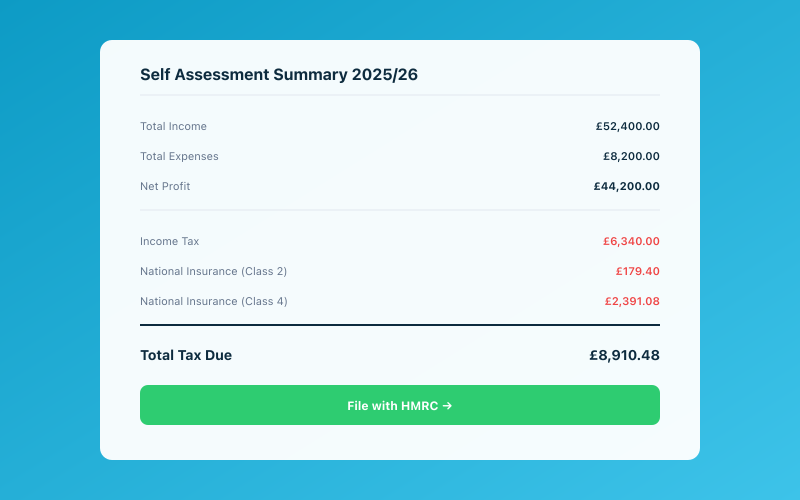 Your Accounted dashboard shows your real-time tax position
Day 1: Immediate £100 Penalty
The moment you miss the filing deadline, HMRC charges you a flat £100 penalty. This applies even if you do not owe any tax, and even if you are only one day late. There is no grace period and no warning.
You do not need to have received a letter from HMRC for the penalty to apply. It is automatic.
3 Months Late: Daily Penalties Begin
If your return is still outstanding 3 months after the deadline (so after 30 April for online returns), HMRC starts charging £10 per day for up to 90 days. That is a maximum of £900 in daily penalties on top of the initial £100.
So at 6 months late, you could already owe up to £1,000 in filing penalties alone — before any tax or interest is added.
6 Months Late: Tax-Based Penalty
At the 6-month mark (31 July for online returns), HMRC adds a further penalty of 5% of the tax due, or £300, whichever is greater.
This is where it starts to really hurt if you owe a significant amount of tax. If your tax bill is £10,000, this penalty alone is £500.
12 Months Late: Another Tax-Based Penalty
At the 12-month mark (31 January of the following year), HMRC adds another 5% of the tax due, or £300, whichever is greater.
In serious cases — where HMRC considers that you deliberately withheld information — this penalty can be increased to 100% of the tax due.
Summary of Filing Penalties
| When | Penalty | |------|---------| | 1 day late | £100 flat penalty | | 3 months late | £10 per day for up to 90 days (max £900) | | 6 months late | 5% of tax due or £300 (whichever is higher) | | 12 months late | Additional 5% of tax due or £300 (whichever is higher) |
Maximum Penalty Example
If your tax bill is £5,000 and you file 12 months late:
- Initial penalty: £100
- Daily penalties (90 days): £900
- 6-month penalty (5% of £5,000): £300 (minimum applies as 5% = £250, which is less than £300)
- 12-month penalty: £300
- Total filing penalties: £1,600
And that is before interest on the unpaid tax.
Late Payment Penalties
Filing late and paying late are two separate things with two separate penalty systems. Even if you file on time, paying late triggers its own penalties.
Interest on Late Payment
HMRC charges interest on any tax paid after the due date. The interest rate changes periodically and is currently 7.25% per year. Interest runs from the day after the payment deadline until the day you pay.
Late Payment Surcharges
On top of interest, HMRC charges surcharges for late payment:
- 30 days late: 5% of the tax unpaid at that date
- 6 months late: A further 5% of the tax still unpaid
- 12 months late: A further 5% of the tax still unpaid
So if you owe £10,000 and do not pay for a full year:
- 30-day surcharge: £500
- 6-month surcharge: £500 (5% of remaining balance)
- 12-month surcharge: £500 (5% of remaining balance)
- Plus interest at 7.25% for the year: approximately £725
That is around £2,225 in penalties and interest on top of the original £10,000 tax bill.
What If You Do Not Owe Any Tax?
Even if your tax bill is zero, you still get the £100 automatic penalty for filing late, and the £10 daily penalties after 3 months. The percentage-based penalties at 6 and 12 months do not apply because there is no tax to calculate them on, but the minimum £300 penalty at each stage does still apply.
Many people think "I don't owe anything, so it doesn't matter." It does. A £100 fine for filing one day late is expensive when you owe nothing.
How to Appeal a Late Filing Penalty
HMRC allows you to appeal penalties if you have a "reasonable excuse" for filing late. You must appeal within 30 days of receiving the penalty notice (though HMRC can accept late appeals if you have a good reason for the delay).
What Counts as a Reasonable Excuse?
HMRC's guidance gives some examples of what they would normally accept:
- Your partner or a close relative died shortly before the deadline
- You had a serious or life-threatening illness that prevented you from dealing with your tax affairs
- You had an unexpected hospital stay
- Your computer or software failed just before or while you were filing
- HMRC's online service was down and you could not file (HMRC will usually know about this)
- A fire, flood, or theft prevented you from completing your return
- Postal delays meant a paper return did not arrive on time (rare these days, and only applies to paper returns)
What Does NOT Count?
- You did not know you needed to file (ignorance of the law is not an excuse)
- You did not receive a reminder from HMRC (you are expected to know your own deadlines)
- You relied on someone else to file for you and they did not (you are still responsible)
- You found the process confusing or difficult
- You were too busy
- Your accountant let you down (HMRC considers this your responsibility, though you may have a claim against the accountant)
How to Appeal
You can appeal online through your HMRC account, by phone, or by post. You will need to explain:
- What your reasonable excuse was
- Why it prevented you from filing on time
- When the excuse ended
- That you filed as soon as you reasonably could after the excuse ended
That last point is important. Even if you had a genuine reason for being late, HMRC expects you to file as soon as the obstacle is removed. If you were ill in January but waited until June to file, your appeal may be rejected.
How to Avoid Missing the Deadline
File Early
You do not have to wait until January. You can file as soon as the tax year ends on 5 April. Filing early does not mean paying early — the payment deadline is still 31 January. But it removes the stress.
Keep Records Throughout the Year
The main reason people file late is spending January pulling records together instead of actually filing. If your bookkeeping is done month by month, filing becomes a quick job.
Use Software That Keeps You Ready
If your bookkeeping is up to date in software like Accounted, filing is straightforward. Penny keeps your income, expenses, and tax calculation current throughout the year, so your figures are ready when you need them.
What to Do If You Have Already Missed the Deadline
If you are reading this and the deadline has already passed, here is what to do:
- File as soon as possible. Every day you wait adds to the daily penalties (once you pass the 3-month mark) and the interest on any unpaid tax.
- Pay what you can. If you cannot pay the full amount, pay whatever you can. This reduces the interest and late payment surcharges.
- Consider a payment plan. HMRC offers Time to Pay arrangements where you can spread your tax bill over up to 12 months. You can set this up online if you owe less than £30,000 and are within 60 days of the payment deadline.
- Appeal if you have a reasonable excuse. If you had a genuine reason for missing the deadline, appeal the penalty. Do this as soon as you receive the penalty notice.
Missing the Self Assessment deadline is stressful but not the end of the world. The sooner you act, the less it costs. Accounted helps you stay on top of your deadlines with built-in reminders and real-time tax calculations, so January never catches you off guard. Start your free trial today and get ahead of your next return.
Related Reading
-
Self Assessment Deadlines 2025/26: Every Date You Need to Know
-
Self Assessment January Rush: How to File on Time Without the Stress
Start your free trial and let Penny handle your bookkeeping automatically.
Penny, your AI bookkeeper, tracks your tax position in real time and flags opportunities to reduce your bill. Meet Penny →
Tax & Compliance Specialists
Our tax specialists have decades of combined experience in UK sole trader and small business taxation, MTD compliance, and HMRC submissions. All content is reviewed against current HMRC guidance before publication and updated quarterly to reflect legislative changes.
Ready to try Accounted?
Join UK sole traders who are simplifying their bookkeeping and tax.
Start your 14-day free trial