Voluntary Disclosure to HMRC — Coming Clean About Past Mistakes
We've all made mistakes. Maybe you forgot to declare a source of income. Perhaps you claimed an expense you shouldn't have, or you realised too late that your figures were wrong. Whatever the error, you're now sitting with the uncomfortable knowledge that your past tax returns aren't entirely accurate.
So what do you do? The instinct is often to do nothing and hope nobody notices. But that's almost always the wrong call. Coming forward voluntarily — before HMRC finds the problem themselves — is not only the right thing to do, it's also the smart thing to do. The penalties are significantly lower, and HMRC treats voluntary disclosures far more favourably than issues they uncover through their own investigations.
Here's how it all works.
What Is a Voluntary Disclosure?
A voluntary disclosure is exactly what it sounds like: you contact HMRC proactively to tell them about an error or omission in your tax affairs. It could relate to a single mistake on one tax return, or it could cover multiple years of errors.
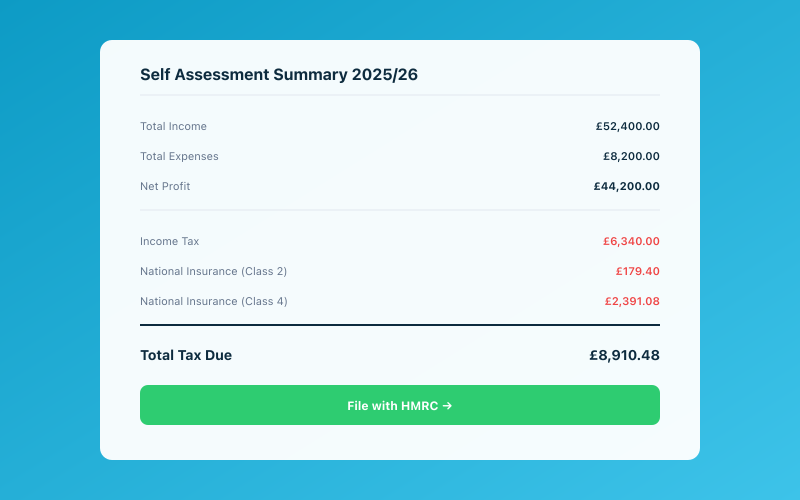 Your Accounted dashboard shows your real-time tax position
The key word is "voluntary." For a disclosure to be genuinely voluntary, HMRC must not have already contacted you about the issue. If HMRC has already opened an enquiry or sent you a letter asking questions about the very thing you're disclosing, it's too late — your disclosure won't be treated as voluntary, and you won't get the reduced penalties.
This is why timing matters. If you know there's a problem, the sooner you act, the better.
Why Should You Come Forward?
There are several compelling reasons to make a voluntary disclosure:
Significantly reduced penalties. This is the big one. HMRC's penalty framework distinguishes between errors you disclose voluntarily ("unprompted") and errors they discover themselves ("prompted"). The difference is substantial:
- For careless errors: unprompted penalties range from 0% to 30% of the additional tax owed, compared with 15% to 30% for prompted disclosures
- For deliberate errors: unprompted penalties range from 20% to 70%, compared with 35% to 70% for prompted disclosures
- For deliberate and concealed errors: unprompted penalties range from 30% to 100%, compared with 50% to 100% for prompted disclosures
In practice, if you come forward, provide full disclosure, and cooperate fully, HMRC will typically apply penalties at the lower end of the range. That could mean the difference between a 0% penalty and a 30% penalty — a very significant saving.
Peace of mind. Living with the knowledge that your tax affairs aren't right is stressful. The constant worry about whether HMRC will find out, combined with the fear of what might happen if they do, takes a real toll. Making a disclosure draws a line under the problem and lets you move on.
HMRC's increasing capabilities. With systems like Connect cross-referencing data from banks, property records, online platforms, and international sources, the chances of errors going undetected are shrinking rapidly. It's not a question of if HMRC will find the problem — it's when. Better to come forward on your terms than wait for them to come to you.
Avoiding criminal prosecution. In cases of serious tax evasion, HMRC can pursue criminal charges. Voluntary disclosure dramatically reduces the risk of criminal action. HMRC's published policy states that they prefer civil resolution (penalties) over criminal prosecution, especially when the taxpayer has come forward voluntarily.
Types of Voluntary Disclosure
There are several routes for making a voluntary disclosure, depending on the nature and scale of the error:
Amending a Tax Return
If the error is on a recent return (within the amendment window — usually twelve months from the original filing deadline), you can simply amend the return through your HMRC online account. This is the simplest route for minor errors on recent returns. Our guide on how to correct a mistake on your Self Assessment walks through this process.
The Digital Disclosure Service
For errors that go beyond the amendment window, or that span multiple years, HMRC's Digital Disclosure Service (DDS) is the main route. The DDS is an online facility that allows you to:
- Notify HMRC that you intend to make a disclosure
- Gather your information and calculate the additional tax owed
- Submit your full disclosure, including the additional tax, interest, and any penalties
- Pay what you owe
The process is designed to be used without professional help, though many people choose to involve an accountant or tax adviser, especially for more complex situations.
Worldwide Disclosure Facility
If your disclosure involves offshore income, assets, or accounts, HMRC's Worldwide Disclosure Facility is the appropriate route. This was introduced in 2016 to encourage people with undeclared offshore interests to come forward. The penalties for offshore non-compliance can be significantly higher than for domestic errors, so early disclosure is even more important in these cases.
Contractual Disclosure Facility (COP9)
In the most serious cases — where HMRC suspects deliberate tax fraud — they may offer a Contractual Disclosure Facility under Code of Practice 9. This gives you the opportunity to make a full disclosure in exchange for HMRC agreeing not to pursue criminal prosecution. This is high-stakes territory and absolutely requires professional legal and tax advice.
The Step-by-Step Process
Here's what a typical voluntary disclosure looks like in practice:
Step 1: Assess the Situation
Before contacting HMRC, take stock of what's gone wrong. Identify which tax years are affected, what the errors are, and how much additional tax might be owed. You don't need exact figures at this stage, but you need a general understanding of the scale of the problem.
Step 2: Notify HMRC
Using the Digital Disclosure Service, notify HMRC that you intend to make a disclosure. You'll receive an acknowledgement and a reference number. At this point, you're not providing details — you're simply telling HMRC that a disclosure is coming.
HMRC will give you a deadline (typically ninety days) to submit your full disclosure. If you need more time — perhaps because gathering the records is complicated — you can request an extension.
Step 3: Gather Your Records
This is often the most time-consuming part. You'll need to reconstruct your finances for the relevant years, identify the correct figures, and calculate the additional tax owed. You'll also need to work out interest (calculated from the date the tax was originally due) and propose a penalty amount.
If you're using Accounted, your digital records can make this much easier. Penny keeps a clear record of your transactions, which means you've got a reliable starting point for identifying where things went wrong.
Step 4: Calculate What You Owe
Your disclosure needs to include:
- The additional tax due for each year
- Interest from the original due date to the date of payment
- A proposed penalty, calculated according to HMRC's guidelines (based on whether the error was careless, deliberate, or deliberate and concealed, and whether you're making a full disclosure)
HMRC provides a calculator tool to help with the interest calculations. For penalty calculations, refer to HMRC's factsheet CC/FS7a.
Step 5: Submit and Pay
Submit your completed disclosure through the DDS and pay the full amount — tax, interest, and penalty — at the same time. If you can't afford to pay everything at once, contact HMRC to discuss a payment plan.
Step 6: HMRC Reviews
HMRC will review your disclosure. If they're satisfied that it's complete and accurate, they'll confirm acceptance. If they have questions or believe the disclosure is incomplete, they may come back to you for further information.
In most cases, once the disclosure is accepted and paid, the matter is closed. You can move forward with clean tax affairs and the knowledge that you're fully compliant.
Common Mistakes People Make
Waiting too long. The benefits of voluntary disclosure disappear if HMRC contacts you first. If you know there's a problem, act now.
Not disclosing everything. If you make a disclosure but hold back some of the errors, and HMRC later discovers the undisclosed ones, you'll face much higher penalties for those — and you'll lose credibility. If you're going to come clean, come fully clean.
Underestimating the tax owed. Be accurate in your calculations. If HMRC thinks you've deliberately underestimated, it undermines the entire disclosure.
Not keeping records of the disclosure process. Document everything — what you disclosed, when, how much you calculated, and what you paid. Keep copies of all correspondence.
Getting Professional Help
For straightforward errors — such as forgetting to declare a small amount of bank interest for one year — you can probably handle the disclosure yourself. For anything more complex, professional advice is strongly recommended.
An experienced accountant or tax adviser can:
- Help you identify all the errors (you might not be aware of all of them)
- Calculate the correct figures, including interest and penalties
- Present the disclosure in the most favourable way
- Negotiate with HMRC on your behalf
- Ensure you don't accidentally say something that makes your position worse
The cost of professional advice is usually far outweighed by the potential savings in penalties.
Moving Forward
Making a voluntary disclosure isn't pleasant, but it's one of the best decisions you can make if your tax affairs aren't right. The penalties are lower, the stress is reduced, and you can finally put the problem behind you.
Going forward, the best way to avoid future errors is to keep your bookkeeping accurate and up to date. Accounted is built for exactly this — Penny helps you track your income and expenses throughout the year, categorise transactions correctly, and maintain the kind of clear, reliable records that make mistakes far less likely.
Related reading:
- How to Correct a Mistake on Your Self Assessment
- Tax Investigation Triggers
- HMRC Investigation — What to Expect
Accounted helps UK sole traders stay on top of their bookkeeping and tax. Start your free 30-day trial at getaccounted.co.uk.
Related Reading
Start your free trial and let Penny handle your bookkeeping automatically.
Accounted files your Self Assessment directly to HMRC, with your return pre-populated from your records. See Self Assessment filing →
Tax & Compliance Specialists
Our tax specialists have decades of combined experience in UK sole trader and small business taxation, MTD compliance, and HMRC submissions. All content is reviewed against current HMRC guidance before publication and updated quarterly to reflect legislative changes.
Ready to try Accounted?
Join UK sole traders who are simplifying their bookkeeping and tax.
Start your 14-day free trial