The 4-Hour Work Week for Sole Traders — Is It Realistic?
Tim Ferriss's "The 4-Hour Work Week" has been one of the most influential business books of the past two decades. Its promise is seductive: design your business so efficiently that you can run it in just four hours a week, freeing up the rest of your time for travel, hobbies, and what Ferriss calls "lifestyle design."
It's a genuinely compelling vision. But if you're a UK sole trader — perhaps a plumber in Manchester, a freelance designer in Bristol, or a personal trainer in Edinburgh — you might have read the book and thought: "That sounds lovely, but I've got invoices to chase, a tax return to file, and a client who needs me on site at 8am tomorrow."
So let's ask the honest question: is the four-hour work week realistic for sole traders? And even if the literal number isn't achievable, are there useful principles we can borrow?
What the Book Actually Proposes
Before we assess its relevance to sole traders, let's be fair about what Ferriss actually recommends. The core ideas aren't just "work less." They're a framework built on four pillars, which Ferriss abbreviates as DEAL:
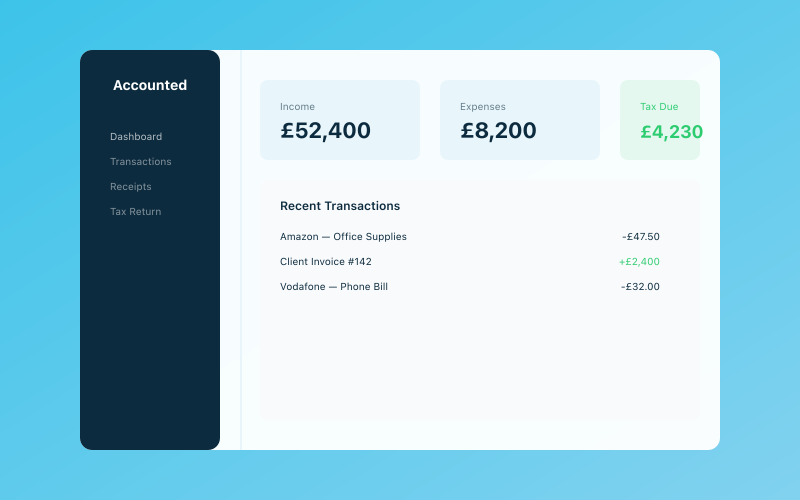 Your Accounted dashboard — income, expenses, and tax at a glance
- D — Definition: Redefine what you want from life and work. Challenge assumptions about what success looks like.
- E — Elimination: Remove unnecessary tasks and distractions. Apply the 80/20 principle ruthlessly.
- A — Automation: Automate or delegate everything that doesn't require your direct involvement.
- L — Liberation: Free yourself from location and time constraints.
These are actually sound business principles. The problem isn't the framework — it's the implication that they'll reduce your working week to four hours.
Why Four Hours Doesn't Work for Most Sole Traders
Let's be direct: if you're a sole trader who delivers a service personally — which is most sole traders — you cannot literally work four hours a week and maintain a viable income. Here's why.
You Are the Product
The fundamental assumption of the four-hour work week is that you can separate yourself from the delivery of your product or service. Ferriss's examples tend to involve e-commerce businesses, info products, or companies with employees who handle operations.
But most sole traders are the product. A freelance copywriter's output is their writing. A photographer's output is their photography. A plumber's output is their plumbing. You can't automate or delegate the core work without fundamentally changing your business model.
Revenue Requires Your Presence
For service-based sole traders, there's a direct relationship between hours worked and money earned. If you charge £50 per hour and need to earn £40,000 a year (from which you'd pay income tax at the basic rate of 20% on earnings above the £12,570 personal allowance, plus National Insurance), you need to bill roughly 800 hours annually, or about 16-17 billable hours per week — assuming you work 48 weeks a year.
That's before admin, marketing, bookkeeping, and all the other non-billable tasks that keep a business running. The maths simply doesn't support four hours a week for most service-based businesses.
The UK Context Matters
Ferriss writes from a US perspective where outsourcing to lower-cost countries is presented as straightforward. While this is possible in the UK too, the practicalities are different. If you're a sole trader serving UK clients who need UK-specific expertise — tax advice, property services, healthcare — you can't easily outsource the core work to a virtual assistant in a different time zone.
There are also regulatory considerations. If you're VAT-registered (mandatory once your turnover hits £90,000), you have quarterly VAT returns to manage. With Making Tax Digital expanding, you'll need to submit quarterly updates to HMRC. These are obligations that require your attention, regardless of how efficient your business is.
What the Book Gets Right
All that said, dismissing the four-hour work week entirely would be a mistake. Several of its core principles are genuinely valuable for sole traders.
The 80/20 Principle Is Powerful
Ferriss's application of the Pareto Principle — that 80% of results come from 20% of efforts — is one of the most useful takeaways. For sole traders, this might mean recognising that:
- 80% of your revenue comes from 20% of your clients
- 80% of your stress comes from 20% of your tasks
- 80% of your marketing results come from 20% of your marketing activities
Identifying the high-impact 20% and focusing your energy there can dramatically improve both your productivity and your quality of life — even if it doesn't reduce your working week to four hours.
Elimination Is Underrated
Most sole traders are doing things they don't need to do. Attending networking events that never generate business. Spending hours on social media platforms where their clients aren't. Creating elaborate proposals for prospects who were never going to convert. Having meetings that could have been emails.
Ferriss's emphasis on ruthless elimination is genuinely liberating. Try this exercise: for one week, track everything you do and note which activities directly contribute to income or client satisfaction. You'll probably find that a surprising amount of your time is spent on tasks that feel productive but aren't.
Automation Is Essential
This is where the four-hour work week is most relevant to sole traders. While you can't automate the delivery of your core service, you absolutely can automate the admin that surrounds it.
Consider how much time you currently spend on:
- Bookkeeping and expense tracking
- Invoicing and payment chasing
- Scheduling and calendar management
- Email management
- Social media posting
- Tax preparation
Each of these can be partially or fully automated. Tools like Accounted handle bookkeeping automatically — Penny can categorise your transactions, track expenses, and keep your tax position up to date without manual effort. Scheduling tools can eliminate the back-and-forth of arranging meetings. Email templates can reduce the time spent on repetitive correspondence. Our guide on automating your admin goes into this in much more detail.
Batching Works
Ferriss advocates for batching similar tasks together rather than context-switching throughout the day. This is excellent advice for sole traders. Instead of checking email constantly, check it twice a day. Instead of doing bookkeeping piecemeal, set aside one session a week (or better yet, automate it entirely). Instead of posting on social media spontaneously, create a week's content in one sitting.
Research on cognitive switching costs shows that every time you switch between different types of task, you lose 15-25 minutes of productive focus. Over a week, that adds up to hours of wasted time.
A More Realistic Goal: The Efficient Work Week
Rather than aiming for a four-hour work week — which for most sole traders is fantasy — aim for an efficient work week. This means:
Maximise Your Effective Hourly Rate
If you can earn the same annual income in fewer hours, you've effectively given yourself a pay rise. This usually involves some combination of:
- Raising your prices — If you're undercharging, every hour you work is less valuable than it should be. See our guide on raising your prices without losing clients.
- Focusing on high-value work — Spend more time on the activities that generate the most revenue and less on everything else.
- Reducing non-billable hours — Every hour spent on admin is an hour you're not earning. Minimise it.
Protect Your Time
This means setting clear boundaries with clients, saying no to low-value work, and guarding your focused work time as fiercely as you'd guard a meeting with your most important client.
Build Systems, Not Just Skills
A sole trader who relies entirely on their own skills and effort will always hit a ceiling. Building systems — standard processes, templates, automated workflows, clear client onboarding procedures — means that the business can operate more smoothly and predictably, even when you're not firing on all cylinders.
Create Space for Rest
The most productive people aren't the ones who work the most hours. They're the ones who work focused hours and then rest properly. A 30-hour week of deep, focused work will outperform a 60-hour week of distracted, exhausted slogging every single time.
The Four-Hour Work Week as Aspiration
Perhaps the best way to think about the four-hour work week isn't as a literal goal but as a direction of travel. You may never get to four hours, but every step in that direction — every task you eliminate, automate, or delegate — improves your working life.
The question isn't "Can I work four hours a week?" It's "Can I work fewer hours than I do now, earn the same or more, and enjoy my work more?" For most sole traders, the answer to that second question is a resounding yes.
Start by identifying one task you can eliminate this week. One process you can automate this month. One boundary you can set this quarter. Small changes compound over time, and a year from now, your working week could look very different — even if it's still considerably more than four hours.
The goal isn't to escape your work. If you've chosen self-employment, presumably you enjoy what you do. The goal is to spend more of your time on the work that matters and less on everything else. That's a goal worth pursuing.
Related reading:
- How to Automate Your Admin So You Can Focus on Your Craft
- Pricing Your Services — A Complete Guide
- Burnout as a Freelancer — The Signs and What to Do About It
Accounted helps UK sole traders stay on top of their bookkeeping and tax. Start your free 30-day trial at getaccounted.co.uk
Related Reading
Business & Operations Advisors
Our business advisors cover the practical side of running a UK sole trader business — from HMRC registration to managing growth. Content is written for real business owners in plain English, not accountants.
Ready to try Accounted?
Join UK sole traders who are simplifying their bookkeeping and tax.
Start your 14-day free trial