The Four-Day Work Week for Freelancers — Is It Possible?
The four-day work week has gone from fringe idea to mainstream conversation in record time. Large-scale trials across the UK, Iceland, and beyond have produced compelling results: happier employees, lower burnout rates, and — perhaps most surprisingly — no drop in productivity. Some companies even reported increased output.
But here is the thing. Almost all of this research has been conducted in traditional workplaces. Offices. Teams. Companies with HR departments and structured workflows. If you are a freelancer or sole trader, you might be looking at these headlines and thinking: "That is lovely, but how on earth does it apply to me?"
It is a fair question. And the answer is more nuanced — and more encouraging — than you might expect.
Why Freelancers Should Care About the Four-Day Week
At first glance, the four-day work week might seem irrelevant to freelancers. After all, one of the supposed benefits of self-employment is that you already control your own schedule. You can work whenever you want, right?
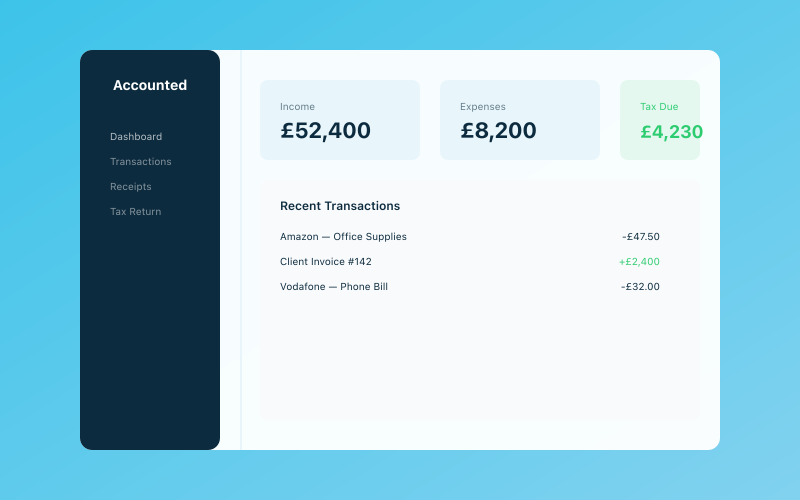 Your Accounted dashboard — income, expenses, and tax at a glance
In theory, yes. In practice, most freelancers work far more than five days a week, not fewer. A 2024 survey by IPSE found that over 40 per cent of UK freelancers regularly work evenings and weekends. The freedom to set your own hours often becomes the freedom to never stop working.
If that sounds familiar, our piece on how to stop working evenings and weekends might strike a chord.
The four-day week is not really about the number of days. It is about being intentional with your time, setting boundaries, and recognising that more hours do not automatically mean more — or better — output. And those principles are just as relevant to someone working from their spare bedroom as they are to someone in a corporate office.
The Maths: Can You Afford It?
Let us address the elephant in the room. When you are self-employed, time quite literally equals money. If you bill by the hour or by the day, working four days instead of five means a 20 per cent cut in potential earnings. That is significant.
But the calculation is not quite that simple. Consider these factors:
Parkinson's Law. Work expands to fill the time available. If you give yourself five days to complete a week's work, it will take five days. Give yourself four, and you will be amazed at how much fat you can trim. Those long email chains, unnecessary meetings, and hours lost to social media scrolling? They contract when your time is genuinely limited.
The productivity curve. Research consistently shows that productivity drops sharply after about five or six hours of focused work. Those final hours of a long day? You are probably producing a fraction of what you managed in the morning. Cutting a day might cost you less output than you think.
Admin and overhead. How much of your five-day week is actually spent on billable, productive work? For most freelancers, a significant chunk goes to admin: invoicing, bookkeeping, emails, marketing, and general business maintenance. Streamlining or automating these tasks — using tools like Accounted to handle your bookkeeping, for instance — can reclaim hours that you can then reinvest in either billable work or a day off.
The value of rest. Burnout is not just unpleasant; it is expensive. When you burn out, your work quality drops, you lose clients, and recovery takes far longer than prevention would have. A regular day off is an investment in your long-term earning capacity.
If you are on irregular income, the idea of deliberately reducing your available working days might feel reckless. But it is worth experimenting during your busy periods first, when the financial pressure is lower.
How to Actually Make It Work
Convinced it is worth trying? Here is a practical framework for implementing a four-day week as a freelancer.
Step 1: Audit your time. Before you change anything, spend two weeks tracking exactly how you use your time. Every task, every distraction, every cup of tea that turned into a forty-five-minute Reddit session. You need to know where your hours are actually going before you can cut intelligently.
Step 2: Identify the low-value activities. Look at your time audit and be ruthless. Which tasks are not directly contributing to income or essential business operations? Which could be automated, delegated, or eliminated entirely? Common culprits include:
- Manual bookkeeping (Penny can handle most of this for you)
- Excessive email checking (try batching it into two or three slots per day)
- Social media without a clear strategy
- Meetings that could have been messages
- Perfectionism on tasks that do not require it
Step 3: Choose your day off. Most freelancers who have tried a four-day week recommend Wednesday or Friday. Wednesday gives you a mid-week reset, which can actually boost productivity on Thursday and Friday. Friday gives you a long weekend, which is better for travel or family time. There is no wrong answer — experiment and see what suits you.
Step 4: Communicate boundaries. Let your clients know your working days. Most will adapt without complaint, especially if your responsiveness and work quality remain high. You do not need to justify or apologise for it. A simple "I am available Monday to Thursday" in your email signature or on your website is sufficient.
Step 5: Protect the day fiercely. This is where most people fail. A four-day week only works if you actually take the day off. That means no "just quickly checking emails," no "I will just finish this one thing," and absolutely no guilt. Your day off is not a luxury — it is a productivity strategy.
The Productivity Gains Are Real
If you are sceptical about whether you can really do five days' work in four, consider the evidence.
The UK's four-day week trial in 2022, which involved 61 companies and around 2,900 workers, found that revenue stayed broadly the same or increased for most participating businesses. Employee wellbeing improved dramatically. And when the trial ended, 92 per cent of companies chose to continue with the four-day model.
Andrew Barnes, the New Zealand entrepreneur who pioneered the concept at his company Perpetual Guardian, puts it simply: "It is about getting people to focus on productivity rather than hours."
For freelancers, this translates into working smarter during your four days. Techniques that can help include:
Time blocking. Dedicate specific blocks to specific types of work. Creative work in the morning when you are freshest. Admin in a focused afternoon slot. Client calls clustered together rather than scattered throughout the day.
The two-hour rule. Identify the two hours in your day when you do your best work and guard them ferociously. No meetings, no emails, no distractions. Use them exclusively for your most important, highest-value tasks.
Batching. Group similar tasks together. Do all your invoicing in one go. Handle all your emails in dedicated slots. Write all your social media posts for the week in a single session. Context-switching is one of the biggest productivity killers, and batching eliminates it.
Saying no. A four-day week forces you to be more selective about the work you take on. This is actually a good thing. When you have less time, you naturally gravitate towards higher-value projects and clients who respect your boundaries.
What About Client Expectations?
This is the concern that stops most freelancers from even trying. "My clients expect me to be available five days a week. If I am not, they will find someone who is."
In reality, this fear is almost always overblown. Most clients care about results, not hours. If you deliver excellent work on time, they will not mind — or even notice — that you are doing it in four days instead of five.
That said, communication is key. Here are some tips:
- Set expectations from the start with new clients
- For existing clients, frame it positively: "I am restructuring my schedule to ensure I am delivering my best work"
- Ensure your response times remain reasonable on your working days
- If a genuine emergency arises on your day off, have a protocol — but make sure emergencies remain genuinely exceptional
Some freelancers find that being unavailable one day a week actually increases their perceived value. Scarcity signals demand.
The Wellbeing Dividend
Beyond productivity, the wellbeing benefits of a four-day week are substantial. Freelancer burnout is a real and growing problem — we have written about the signs and solutions elsewhere on this blog.
A regular, protected day off gives you:
- Time to exercise, socialise, and pursue hobbies (all of which improve cognitive function and creativity)
- Space to think strategically about your business rather than being perpetually stuck in the doing
- A genuine break from the mental load of self-employment
- Better sleep, which research consistently links to improved decision-making and productivity
- A sense of control over your time, which is one of the strongest predictors of overall life satisfaction
Try It as an Experiment
If committing to a permanent four-day week feels too daunting, try it as a time-limited experiment. Give yourself four weeks. Track your output, your income, your stress levels, and your overall satisfaction. At the end, compare the data.
Most freelancers who try this experiment do not go back. Not because the maths changed, but because the experience of having a full day each week that belongs entirely to them — no clients, no deadlines, no admin — is too valuable to give up.
You became a freelancer for freedom. It might be time to actually use some of it.
Accounted helps UK sole traders stay on top of their bookkeeping and tax. Start your free 30-day trial at getaccounted.co.uk.
Related reading:
- How to Stop Working Evenings and Weekends
- Freelancer Burnout — Signs and Solutions
- How to Manage Irregular Income With Smart Budgeting
Related Reading
Start your free trial and see how Accounted simplifies your bookkeeping.
Business & Operations Advisors
Our business advisors cover the practical side of running a UK sole trader business — from HMRC registration to managing growth. Content is written for real business owners in plain English, not accountants.
Ready to try Accounted?
Join UK sole traders who are simplifying their bookkeeping and tax.
Start your 14-day free trial