The Art of Saying No — Protecting Your Time and Energy
Early in your self-employed career, you say yes to everything. Every project, every client, every request, every "quick favour." You say yes because you need the money, because you're building your reputation, because you're terrified that saying no will mean the work dries up and you'll have to go back to a proper job.
And for a while, saying yes to everything works. Your calendar fills up. Your income grows. You feel busy and productive and like you're doing this self-employment thing properly.
Then one day you realise you're working sixty hours a week, half your projects are for clients you don't like, you haven't taken a day off in three months, and you're so stretched thin that the quality of your work is starting to slip. The yes-to-everything strategy that got you started is now the thing that's breaking you.
Learning to say no isn't a nice-to-have skill for freelancers and sole traders. It's survival.
Why Saying No Feels So Difficult
Let's start by acknowledging that saying no is genuinely hard, especially when you work for yourself. There are real, practical reasons for this.
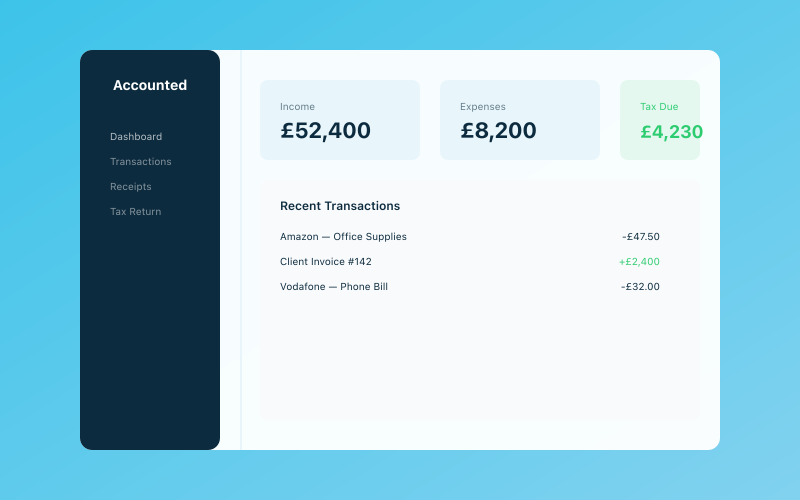 Your Accounted dashboard — income, expenses, and tax at a glance
Financial anxiety. When your income is unpredictable, turning down paid work feels reckless. What if the next opportunity doesn't come? What if this was the one that would have covered next month's rent? The scarcity mindset is powerful and it makes every "no" feel like a gamble.
People-pleasing. Many of us were raised to be accommodating, helpful, and agreeable. Saying no feels rude, selfish, or ungrateful. We worry about disappointing people, damaging relationships, or being seen as difficult.
Fear of missing out. What if this project leads to bigger things? What if this client becomes your best one? The hypothetical future benefits of saying yes can feel more compelling than the very real present costs.
Identity. For many self-employed people, their work is their identity. Being busy feels like being successful. Saying no feels like admitting you can't handle it, which feels like failure.
These feelings are all valid, but they're also all manageable. The trick is learning to override the emotional impulse to say yes and replace it with a more considered approach.
The Cost Of Always Saying Yes
Before we talk about how to say no, let's be clear about what happens when you don't.
Burnout. The most obvious consequence. When you take on more than you can handle, something eventually gives — and it's usually your health, your relationships, or the quality of your work. Often all three. If you're already feeling the strain, our piece on freelancer burnout is worth reading.
Resentment. When you say yes to things you should have said no to, you end up resenting the work, the client, and often yourself. That resentment bleeds into everything and makes the work worse.
Opportunity cost. Every hour you spend on a low-value project is an hour you can't spend on a high-value one. Every client slot you fill with someone who drains your energy is a slot that could have gone to someone who energises you.
Declining quality. You can't do your best work when you're overcommitted. Deadlines get tighter, attention gets thinner, and the standard drops. Which damages your reputation — the very thing you were trying to protect by saying yes in the first place.
No time for admin. When every hour is booked with client work, the behind-the-scenes stuff — bookkeeping, invoicing, tax prep — gets pushed to evenings and weekends. This is where tools like Accounted become genuinely valuable. Penny handles your bookkeeping automatically, which means even when your schedule is packed, your finances aren't being neglected.
How To Actually Say No
Right, the practical bit. Here are approaches that work.
The straightforward no
Sometimes the simplest approach is the best. A clear, polite decline with no lengthy explanation:
"Thanks so much for thinking of me. Unfortunately, I'm not able to take this on right now. I hope you find someone brilliant for it."
That's it. You don't owe anyone a detailed justification for how you spend your time. A short, warm response that closes the door without slamming it.
The redirect
If you can't take the work but know someone who could, say so:
"I'm at capacity at the moment, but I think [name] would be a great fit for this. Shall I make an introduction?"
This feels generous, maintains the relationship, and helps a fellow freelancer. Everyone wins.
The "not now, but maybe later"
If you're interested in the work but the timing is wrong:
"I'd love to work together, but I'm fully booked until [month]. If the timing works on your end, I'd be happy to revisit this then."
This keeps the door open without overcommitting your present self.
The conditional yes
Sometimes a project is appealing but the terms aren't right. Instead of accepting bad terms or declining outright, negotiate:
"I'd be happy to take this on, but with my current workload, I wouldn't be able to start until [date] / I'd need to adjust the scope to [revised scope] / my rate for this kind of work is [rate]."
You'd be surprised how often clients are willing to adjust when presented with clear, reasonable conditions.
The boundary-setting no
For existing clients who keep adding to your plate:
"I want to make sure I do great work on [current project], so I'm not able to add [additional request] to my plate right now without it affecting quality. Shall we discuss reprioritising, or would you prefer to schedule this as a separate project?"
This positions your "no" as a commitment to quality, not a rejection.
Things You Should Almost Always Say No To
While every situation is different, here are some reliable red flags:
Work that pays significantly below your rate. Unless there's a compelling strategic reason (a portfolio piece, a dream client, a cause you believe in), underpricing your work sets a precedent that's hard to reverse.
Clients who disrespect your boundaries from the start. If they're emailing at midnight and expecting instant replies before you've even signed a contract, it's only going to get worse. We've written a whole guide on setting boundaries with clients that covers this in detail.
Scope creep disguised as "quick favours." If a client routinely asks for "just one more thing" that isn't covered by your agreement, that's scope creep. It deserves a separate conversation, not an automatic yes.
Projects that make you feel dread. Trust your gut. If your first reaction to a project enquiry is a sinking feeling rather than excitement (or even neutral interest), pay attention to that.
Anything that requires you to work evenings and weekends as standard. Occasional crunch is part of self-employment. Permanent crunch is a sign that you're taking on too much. If this sounds familiar, have a read of our piece on how to stop working evenings and weekends.
The Guilt Will Pass
The hardest part of saying no isn't the saying — it's the feeling afterwards. The stomach-churning worry that you've made a mistake. The replaying of the conversation in your head. The urge to send a follow-up email taking it back.
This is normal, and it passes. Usually within a few hours, sometimes a day. What you'll notice on the other side of that guilt is something unexpected: relief. Space. The freedom to focus on the work you actually want to do, for the clients you actually enjoy working with.
Over time, saying no gets easier. Not because you stop caring about people's feelings — you'll always care about that — but because you start to see the results. Better work. Better clients. More time. Less stress. A business that works for you rather than consuming you.
Building A Business That Doesn't Require Constant Yes-ing
The long-term goal isn't to become someone who says no all the time. It's to build a business where you rarely have to, because the right opportunities come to you and the wrong ones are filtered out before they even reach your desk.
This means:
- Raising your rates so each project brings in more revenue, reducing the number of clients you need.
- Defining your niche so you attract the right kind of work and naturally repel the wrong kind.
- Building systems that handle the operational side of your business, freeing your time for the work that matters. Accounted is one of those systems — by letting Penny manage your bookkeeping, you reclaim hours each month that would otherwise be spent on admin.
- Creating a waitlist mentality where clients understand that your time is valuable and limited.
- Saying no early and often so you're never in the position of saying yes out of desperation.
None of this happens overnight. It's a gradual shift that takes months or years of deliberate choices. But every "no" to the wrong thing is a "yes" to the right one.
Start Small
If saying no feels terrifying, start with something low-stakes. Turn down a request that doesn't matter much. Decline an invitation you don't want to accept. Set a small boundary and see what happens.
Nine times out of ten, nothing bad happens. The person says "no worries" and moves on. The opportunity you declined gets filled by someone else. The world keeps turning.
And you, meanwhile, have a little more time, a little more energy, and a little more space to do the work you actually care about.
That's not selfish. That's sustainable.
Related reading:
- Setting Boundaries with Clients — A Complete Guide
- How to Stop Working Evenings and Weekends
- Freelancer Burnout — Signs and Solutions
Accounted helps UK sole traders stay on top of their bookkeeping and tax. Start your free 30-day trial at getaccounted.co.uk.
Related Reading
- The Four-Day Work Week for Freelancers — Is It Possible?
- Work-Life Balance When Your Office Is Your Living Room
Start your free trial and see how Accounted simplifies your bookkeeping.
Business & Operations Advisors
Our business advisors cover the practical side of running a UK sole trader business — from HMRC registration to managing growth. Content is written for real business owners in plain English, not accountants.
Ready to try Accounted?
Join UK sole traders who are simplifying their bookkeeping and tax.
Start your 14-day free trial