Making Tax Digital: Everything UK Sole Traders Need to Know Before April 2026
The Clock Is Ticking
Making Tax Digital for Income Tax Self Assessment (MTD for ITSA) is no longer a distant government initiative you can safely ignore. The first phase launches in April 2026, and if you're a sole trader or landlord earning above a certain threshold, it affects you directly.
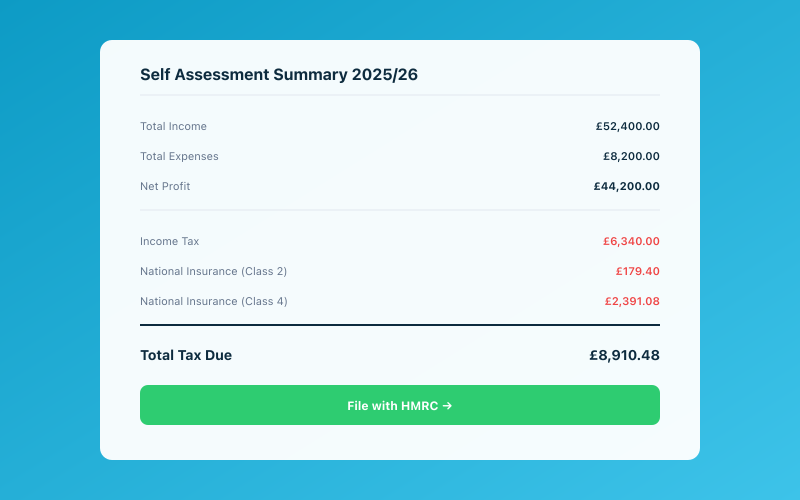 Your Accounted dashboard shows your real-time tax position
Yet a staggering number of sole traders still aren't sure what MTD actually requires, when the deadlines fall, or what they need to do right now to prepare. If that sounds like you, don't worry — you're in exactly the right place.
This guide covers everything: what MTD for ITSA is, who it affects, the key dates you need in your calendar, what quarterly updates actually mean in practice, and how to make the entire process as painless as possible.
What Is Making Tax Digital for ITSA?
Making Tax Digital (MTD) is HMRC's long-running programme to modernise the UK tax system. You may already be familiar with MTD for VAT, which has required VAT-registered businesses to keep digital records and submit returns through compatible software since 2019.
MTD for ITSA extends the same principle to income tax. Instead of filing a single Self Assessment tax return once a year, sole traders and landlords will be required to:
- Keep digital records of all income and expenses using HMRC-compatible software
- Send quarterly updates to HMRC summarising their business income and expenses
- Submit a final declaration at the end of the tax year, replacing the traditional Self Assessment return
The goal, according to HMRC, is to reduce errors, give taxpayers a clearer picture of their tax position throughout the year, and bring the tax system into the digital age.
Who Is Affected?
MTD for ITSA is being rolled out in phases based on your gross income from self-employment and/or property:
Phase 1 — April 2026
Sole traders and landlords with gross income above £50,000 must comply from 6 April 2026. This is the first mandatory group, and it is coming up fast.
Phase 2 — April 2027
The threshold drops to £30,000. If your gross self-employment or property income exceeds thirty thousand pounds, you'll need to be using compatible software and submitting quarterly updates from April 2027.
Phase 3 — To Be Confirmed
HMRC has signalled that the threshold will eventually drop to £20,000, though the exact date for this phase has not yet been formally confirmed. The direction of travel is clear: MTD will eventually cover the vast majority of sole traders.
Important: The threshold is based on gross income (your total turnover), not your profit. Even if your expenses bring your taxable profit well below the threshold, you may still be required to comply if your turnover exceeds it.
Are You Affected?
If you're a sole trader or receive rental income, ask yourself: did your gross income from those sources exceed £50,000 in the 2024/25 tax year? If yes, you're in the first wave. If you're between £30,000 and £50,000, you have until April 2027 — but there's every reason to start preparing now.
The Key Dates You Need to Know
Here are the critical dates for the first MTD for ITSA cohort:
| Date | What Happens | |------|-------------| | 6 April 2026 | MTD for ITSA goes live for those earning over £50,000 | | 5 July 2026 | First quarterly update due (covering 6 April – 5 July) | | 5 October 2026 | Second quarterly update due | | 5 January 2027 | Third quarterly update due | | 5 April 2027 | Fourth quarterly update due | | 31 January 2028 | Final declaration due for the 2026/27 tax year |
That first quarterly update in July 2026 is your real deadline to have everything set up and running smoothly. Which means the time to prepare is now.
What Do Quarterly Updates Actually Involve?
This is where many sole traders start to feel anxious, so let's demystify it.
A quarterly update is a summary of your business income and expenses for that quarter. You don't need to calculate your tax liability each quarter — you simply need to report what came in and what went out, categorised appropriately.
In practice, a quarterly update includes:
- Total income received during the quarter
- Expenses broken down by category (e.g., travel, office supplies, professional fees, stock purchases)
- Any adjustments for items like personal use of business assets
Your MTD-compatible software handles the formatting and submission to HMRC. You don't need to log into the HMRC website or fill in forms manually. The software sends a digital summary directly through HMRC's API.
Think of it like this: If you're already keeping your books up to date — recording income, categorising expenses, reconciling your bank account — then a quarterly update is essentially just pressing "submit." The hard part isn't the submission. It's keeping your records in order throughout the quarter.
How to Prepare Right Now
Even if you're not in the first wave (earning over £50,000), getting ready early is strongly advisable. Here's what to do:
1. Choose MTD-Compatible Software
You need software that is officially recognised by HMRC as compatible with MTD for ITSA. Not all bookkeeping apps qualify. Accounted is fully MTD-compatible, with direct API integration to HMRC for both quarterly updates and final declarations.
2. Start Keeping Digital Records
If you're still using spreadsheets, paper receipts in a shoebox, or a combination of manual methods, now is the time to move to digital record-keeping. MTD requires that your records are maintained digitally — and that means in compatible software, not in a spreadsheet you email to your accountant once a year.
3. Connect Your Bank Account
The single most impactful thing you can do is connect your business bank account to your bookkeeping software. This automates the flow of transactions and eliminates the biggest source of errors: manual data entry.
4. Get Your Categories Right
HMRC expects expenses to be categorised according to their standard categories (which align with the Self Assessment tax return). Make sure your software maps your spending to the right categories. If you're using Accounted, our AI engine handles this automatically with over 95% accuracy.
5. Catch Up on Historical Records
If your records for the current tax year are incomplete, now is the time to catch up. Having clean, complete records from 6 April 2025 onwards will make the transition to MTD far smoother.
6. Talk to Your Accountant
If you work with an accountant, have a conversation about MTD now. Ask them which software they recommend, whether they'll be submitting quarterly updates on your behalf, and how your workflow together might change.
How Accounted Makes MTD Painless
We built Accounted specifically for UK sole traders navigating MTD. Here's how we take the stress out of the process:
Automatic Bank Feeds. Connect your bank account and every transaction flows in automatically. No manual entry, no missed transactions, no end-of-quarter scramble.
AI-Powered Categorisation. Our AI engine, Penny, categorises every transaction against HMRC-standard categories. She learns your patterns over time and achieves over 95% accuracy — and when she's unsure, she asks you via WhatsApp rather than guessing.
Receipt Capture via WhatsApp. Snap a photo of a receipt and send it to Penny on WhatsApp. She reads it using OCR, matches it to the right transaction, and stores it digitally. HMRC requires you to keep records for five years — Accounted handles that automatically.
One-Tap Quarterly Submissions. When the quarter ends, Accounted prepares your quarterly update automatically. Review the summary, tap submit, and it goes directly to HMRC through their official API. The whole process takes less than five minutes.
Real-Time Tax Estimates. Because your books are always up to date, Accounted can show you an estimated tax liability at any point during the year. No more nasty surprises in January.
Built for Sole Traders. Unlike Xero or QuickBooks, which were designed for larger businesses and bolt on sole trader features as an afterthought, Accounted is built from the ground up for sole traders and landlords. The interface is simple, the pricing is straightforward, and every feature is designed around your needs.
Common Questions
Do I still need to file a Self Assessment return? The final declaration under MTD replaces the traditional Self Assessment return. However, during the transition period, some taxpayers may still need to complete a Self Assessment return for income not covered by MTD (e.g., employment income, dividends). HMRC will provide guidance specific to your circumstances.
What happens if I miss a quarterly update? HMRC has stated that there will be a "soft landing" period with no penalties for late quarterly updates in the first year. After that, a points-based penalty system will apply — similar to the system already in place for MTD for VAT.
Can my accountant submit on my behalf? Yes. Your accountant can be authorised to submit quarterly updates and the final declaration on your behalf using agent services. If you use Accounted, you can invite your accountant to your account so they have visibility of your records and can submit directly.
What if my income fluctuates around the threshold? If your gross income was above the threshold in the previous tax year, you're required to comply — even if your income drops below it in the current year. Check HMRC's detailed guidance for the rules on entering and leaving MTD.
Don't Leave It Until the Last Minute
The biggest mistake you can make with MTD is waiting until April 2026 to think about it. The sole traders who find MTD stressful will be the ones who scramble to set up software, backfill months of records, and learn a new system all at once.
The ones who find it painless? They'll be the ones who set things up now, let the software do the heavy lifting throughout the year, and arrive at their first quarterly update with everything already in order.
Get Ready for MTD with Accounted
Accounted is the simplest way for UK sole traders to comply with Making Tax Digital. Connect your bank, let Penny categorise your transactions, and submit quarterly updates to HMRC with a single tap.
Start your free trial today and be MTD-ready in minutes, not months.
Start Your Free Trial | See How It Works
Related Reading
-
Making Tax Digital 2026: The Complete Guide for Self-Employed
-
MTD for Income Tax — The Complete Timeline of What's Changing
See how Accounted handles MTD and start your free trial.
Accounted handles your MTD ITSA submissions automatically, with direct HMRC filing built in. See how MTD works in Accounted →
Tax & Compliance Specialists
Our tax specialists have decades of combined experience in UK sole trader and small business taxation, MTD compliance, and HMRC submissions. All content is reviewed against current HMRC guidance before publication and updated quarterly to reflect legislative changes.
Ready to try Accounted?
Join UK sole traders who are simplifying their bookkeeping and tax.
Start your 14-day free trial