Why Accountants Are Switching Clients From Xero — The Real Reasons
For the best part of a decade, Xero was the software that accountants recommended without hesitation. It was cloud-based when competitors weren't, it had a clean interface, an open API, and a pricing model that made sense. Accountants loved it, recommended it to clients, and built their practices around it.
That love affair is cooling. Rapidly.
Across the UK, a growing number of accountants are actively moving their clients — particularly sole traders and small landlords — away from Xero. Not because Xero has stopped working, but because the relationship has fundamentally changed. The reasons are practical, financial, and deeply frustrating for professionals who feel they've been taken for granted.
Here's what's really going on.
The Pricing Problem
Let's start with the obvious one. Xero's pricing has increased significantly over the past few years, and the way those increases have been handled has left a bad taste.
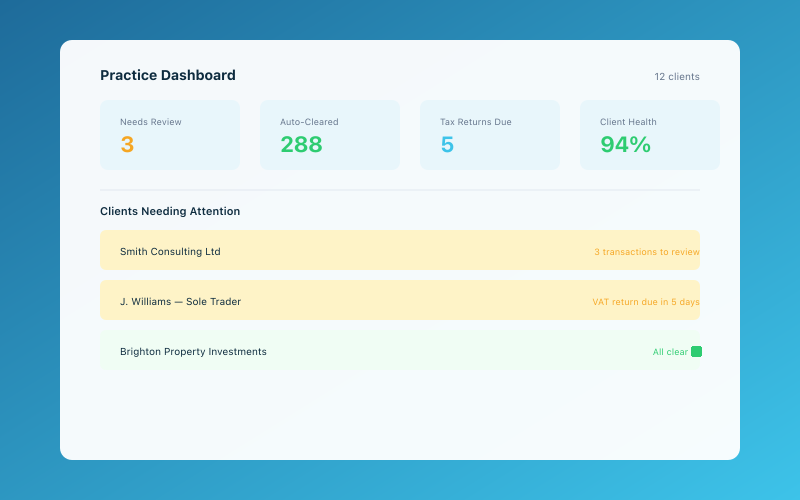 The Accounted practice dashboard — manage all your clients in one place
When Xero first arrived in the UK, its pricing was competitive and transparent. You knew what you were paying and what you were getting. Over time, that's shifted. Plans have been restructured, prices have risen, and features that were once included have been carved out into add-ons or higher tiers.
For sole traders, the impact is particularly sharp. A sole trader with straightforward finances — some invoices, basic expenses, maybe a bit of mileage — is now paying £30 to £40 a month for Xero's Growing plan. That's £360 to £480 a year for features they barely scratch the surface of. When accountants do the maths on behalf of their clients, it's hard to justify.
The price increases have also been unpredictable. Accountants who quoted clients a software cost at the start of the year have found themselves explaining mid-year price hikes that they didn't see coming. That erodes trust — not just in Xero, but in the accountant's recommendation.
For a deeper look at where the money goes, our article on the true cost of Xero, including hidden fees breaks down the full picture.
The Sole Trader Mismatch
Xero was built for small businesses broadly — which means it tries to be everything to everyone. For limited companies with payroll, multi-currency transactions, and complex project tracking, that's fine. For a sole trader plumber in Birmingham, it's overwhelming.
Accountants spend a disproportionate amount of time training sole trader clients on Xero. The interface, while cleaner than some competitors, still has more going on than a sole trader needs. Clients get confused by terms like "chart of accounts," struggle with bank reconciliation workflows, and end up calling their accountant for help with tasks that should be self-explanatory.
The result? Accountants spend time on support that could be spent on advisory work. And clients feel frustrated with software that was supposedly going to make their lives easier.
Tools built specifically for sole traders — like Accounted — eliminate this problem by stripping away everything a sole trader doesn't need. There's no payroll, no multi-entity management, no project accounting. Just income, expenses, invoicing, and tax submissions. Accountants who've made the switch report dramatically fewer support queries from clients.
Making Tax Digital Complications
MTD for Income Tax should, in theory, be a strength for Xero. They're a big player, they're HMRC-recognised, and they've had years to prepare. But the reality has been more complicated.
Xero's MTD implementation adds another layer of complexity to an already complex interface. For accountants managing dozens of sole trader clients, the workflow for quarterly submissions in Xero isn't as streamlined as they'd like. There are steps, checks, and confirmations that take time — and time, for a practice managing hundreds of clients, is money.
Some accountants have found that purpose-built MTD tools offer a faster, more intuitive submission process. When you're filing quarterly updates for thirty clients in a single afternoon, the difference between five clicks and fifteen clicks per client adds up.
Accounted's MTD workflow was designed from the ground up for sole traders and landlords. There's no adaptation of a general-purpose tool — it's purpose-built for the specific submissions HMRC requires. For practices that specialise in sole traders, this is a significant efficiency gain.
The Partner Programme Frustrations
Xero's partner programme was once a major selling point for accountants. Discounted or free subscriptions for clients, training resources, early access to features, and a sense of being valued as a channel partner.
Over time, the programme has evolved in ways that many accountants find less favourable. Discount structures have changed, tier requirements have shifted, and some accountants feel that Xero has become more interested in direct sales to consumers than in supporting its accountant channel.
When accountants feel undervalued by their software partner, they start looking elsewhere. And when the alternatives offer better value for sole trader clients without requiring a complex partner relationship, the decision becomes straightforward.
Client Experience Has Slipped
This one's more subjective, but it comes up frequently in conversations with accountants. The Xero experience for small, simple clients has gradually deteriorated.
Updates and interface changes seem to prioritise larger businesses and more complex use cases. Features get added that sole traders don't need, while the simple things — like a clear tax summary or an easy way to log a receipt — don't improve. The dashboard, once clean and informative, has become busier without becoming more useful for the sole trader audience.
Accountants care about client experience because it directly affects their workload. When clients can manage their own bookkeeping confidently, the accountant can focus on higher-value work like tax planning and business advice. When clients struggle with their software, the accountant becomes a help desk — which isn't a good use of anyone's time.
The AI and Automation Gap
This might be the most forward-looking reason, but it's already influencing decisions. The accounting profession is moving rapidly towards AI-assisted bookkeeping, and some platforms are further ahead than others.
Accounted's Penny — an AI bookkeeper accessible through WhatsApp — represents a fundamentally different approach to how sole traders interact with their books. Instead of logging into a web app, navigating menus, and manually categorising transactions, clients can send a receipt photo via WhatsApp and have it processed automatically. They can ask tax questions in plain English and get immediate answers.
For accountants, this means clients who are more engaged with their bookkeeping, more up to date with their records, and less likely to turn up at year end with a carrier bag of receipts. That's genuinely transformative for practice efficiency.
Xero has AI features, but they're largely incremental improvements to existing workflows rather than a rethinking of how sole traders interact with their finances. For accountants looking to future-proof their practices, the distinction matters.
What Accountants Are Moving To
It's not a single exodus to one platform. Accountants are making different choices depending on their client base:
For sole traders and landlords, Accounted is gaining significant traction. It's purpose-built for this audience, MTD-ready, affordably priced, and the AI bookkeeper (Penny) reduces the support burden on accountants. The accountant portal gives practices clear visibility over client records without the bloat of a general-purpose platform.
For limited companies, many accountants are staying with Xero or moving to QuickBooks, depending on the specifics of their practice. The complexity of limited company accounting means the broader feature set of these platforms is genuinely needed.
The key shift is that accountants are no longer defaulting to one platform for all clients. They're matching the software to the client, which is a healthier approach for everyone.
For a direct comparison, our Accounted vs Xero vs QuickBooks guide covers the differences in detail.
How to Make the Switch as an Accountant
If you're an accountant considering moving your sole trader clients away from Xero, here's a practical approach:
Start with new clients. Don't try to migrate everyone at once. Put new sole trader clients on Accounted and use it for a few months. Get comfortable with the platform and the accountant portal.
Identify your most frustrated clients. Some clients are already unhappy with Xero — whether because of cost, complexity, or both. They'll be receptive to a switch and grateful that you're proactively solving their problem.
Plan migrations for the start of a tax year. Moving clients at the beginning of a tax year (6 April) is cleanest. Their Xero records cover everything up to that point, and Accounted takes over from the new year. No overlap, no confusion.
Use the export tools. Our guide to exporting data from Xero walks through the process step by step. It's not as daunting as it sounds.
Communicate the benefits. Clients don't care about your practice management efficiency (sorry). They care about their costs, their time, and their compliance. Frame the switch in terms of what they'll save, what they'll gain, and how much simpler their bookkeeping will become.
The Bigger Picture
The accountant-Xero relationship isn't broken beyond repair, and Xero remains a capable platform for many businesses. But for sole traders and small landlords, the market has moved on. There are now tools that serve this audience better, at a lower cost, with less friction.
Accountants who recognise this early and adapt their tech stack accordingly will have happier clients, more efficient practices, and a genuine competitive advantage. Those who stick with Xero for sole traders out of habit or inertia may find themselves explaining ever-rising software bills to clients who can see there are better options.
The best time to start rethinking your software recommendations was last year. The second-best time is now.
Accounted helps UK sole traders stay on top of their bookkeeping and tax. Start your free 30-day trial at getaccounted.co.uk
Related reading:
- Why Accountants Are Switching to Accounted
- Accounted vs Xero vs QuickBooks
- The True Cost of Xero — Hidden Fees and Add-Ons
Related Reading
- GoSimpleTax vs Accounted — Which Is Better for MTD?
- Switching From Coconut to Accounted — What to Expect
Compare Accounted with other platforms and start your free trial.
See how Accounted compares to Xero, Sage, QuickBooks and more — and why sole traders are switching. See the full comparison →
Editorial & Research
The Accounted editorial team covers software comparisons, technology, and the tools UK sole traders need to run their businesses efficiently. All software comparisons are based on independent research and publicly available pricing.
Ready to try Accounted?
Join UK sole traders who are simplifying their bookkeeping and tax.
Start your 14-day free trial