Is FreeAgent Really Free with NatWest? The Fine Print
The NatWest + FreeAgent Deal — Sounds Too Good to Be True?
If you've got a NatWest, Royal Bank of Scotland, or Ulster Bank business account, you can get FreeAgent completely free. No monthly fees, no trial period, no catch. Or so it seems.
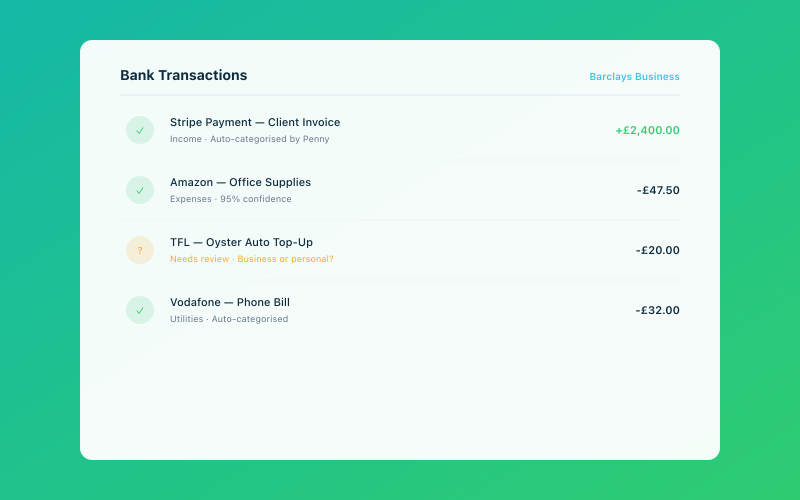 Penny auto-categorises your bank transactions with 95%+ accuracy
It's a genuinely good offer. FreeAgent normally costs £14.50 to £32 per month, so free access saves you between £174 and £384 a year. That's real money, especially when you're starting out.
But "free" is a word that always deserves a closer look. So let's dig into the fine print, the limitations, and the situations where free accounting software might actually cost you more than paying for something else.
How the Deal Works
NatWest Group acquired FreeAgent back in 2018. Since then, they've offered free FreeAgent access to holders of eligible business current accounts across their banking brands.
Here's who qualifies:
- NatWest business current account holders
- Royal Bank of Scotland business current account holders
- Ulster Bank (Northern Ireland) business current account holders
You sign up for FreeAgent through your online banking, and your account is linked automatically. Simple as that.
What You Get
The free version is the full FreeAgent product. You're not getting a stripped-down lite version — you get everything a paying customer gets:
- Unlimited invoices and expenses
- Bank feed integration
- Self-assessment filing
- VAT returns (MTD-compliant)
- Basic reporting
- Multi-currency invoicing
- Time tracking
- Project management
On paper, that's excellent. And for many people, it genuinely is.
The Fine Print Worth Understanding
1. You Must Maintain Your NatWest Business Account
This is the obvious one, but it's worth spelling out. If you close your NatWest business account, you lose free FreeAgent access. Your data doesn't disappear — you can continue using FreeAgent by paying the standard subscription — but you'll go from paying nothing to paying up to £32 per month overnight.
This creates a form of lock-in. If you find a better business bank account with lower fees, better interest rates, or better features, there's a hidden switching cost: you'll also need to start paying for your accounting software.
2. Bank Fees Still Apply
FreeAgent might be free, but your NatWest business account isn't necessarily free. NatWest business accounts can come with monthly fees, transaction charges, and other costs depending on your account type and usage.
Make sure you're comparing the total cost — bank fees plus accounting software — rather than just looking at the FreeAgent bit in isolation. A cheaper bank account plus paid accounting software could work out less expensive overall.
3. Support Priority
NatWest-sourced FreeAgent users get the same software, but anecdotally, some users have reported that support response times can vary. FreeAgent's support team handles a massive volume of NatWest users who may be less technically confident with accounting software. This can mean longer wait times during busy periods like January self-assessment season.
To be fair, FreeAgent's support is generally well-regarded. But it's worth having realistic expectations.
4. You're Still Doing the Work
This is the big one that most people don't think about as a "cost," but it absolutely is.
FreeAgent is accounting software. It's well-designed accounting software, but it still requires you to:
- Categorise transactions regularly
- Reconcile your bank feed
- Create and send invoices
- Enter expenses and attach receipts
- Understand basic accounting concepts
- Run and review reports
- File VAT returns and self-assessments correctly
If you're comfortable with all of that, great. But if you're a sole trader who'd rather focus on your actual work, the time you spend doing bookkeeping in FreeAgent is a real cost — even if the software itself is free.
The average small business owner spends 5-10 hours per month on bookkeeping. At even a modest hourly rate, that's a significant amount of money tied up in admin.
When Free Isn't Actually Cheaper
Here's an example that illustrates the point.
Option A: Free FreeAgent with NatWest
- FreeAgent: £0/month
- NatWest business account: varies (let's say £6.50/month)
- Your time doing bookkeeping: 6 hours/month × £30/hour = £180/month
- Total real cost: ~£186.50/month
Option B: Paid accounting tool that does the work for you
- Accounted (with Penny AI bookkeeper): from £10/month
- Any bank account: varies
- Your time: minimal — Penny handles categorisation, receipt management, and compliance
- Total real cost: significantly less when you factor in time
The point isn't that FreeAgent is bad — it's that "free software" and "free bookkeeping" are two very different things. If you value your time (and you should), the cheapest software isn't always the cheapest solution.
FreeAgent's Strengths (Credit Where It's Due)
Let's be balanced here. FreeAgent has genuine strengths:
UK-First Design
FreeAgent was built in Edinburgh for UK businesses. Unlike QuickBooks (US-origin) or Xero (New Zealand-origin), FreeAgent's tax calculations, terminology, and workflows are British from the ground up. Self-assessment is built in, not bolted on.
Self-Assessment Filing
FreeAgent can file your self-assessment tax return directly with HMRC. This is a genuinely useful feature that saves time and the cost of a separate filing tool.
Friendly Interface
Compared to Xero or Sage, FreeAgent's interface is more approachable. The dashboard gives you a clear picture of your finances, and the navigation is relatively intuitive. If you're going to use traditional accounting software, FreeAgent is one of the easier options to learn.
MTD Compliance
FreeAgent is fully MTD-compliant for VAT, and it's preparing for MTD for Income Tax. If you need to file digital VAT returns or get ready for quarterly submissions, FreeAgent handles this.
Good for Contractors
FreeAgent has particularly strong features for contractors and freelancers, including IR35 tools, project-based billing, and time tracking.
FreeAgent's Limitations
Reporting Could Be Better
FreeAgent's reports are adequate but not exceptional. If you need detailed management accounts, custom reports, or advanced financial analysis, you may find FreeAgent lacking compared to Xero or Sage.
Limited Scalability
FreeAgent works well for sole traders and small businesses, but if you grow to the point of needing multiple users, complex inventory, or advanced payroll, you may outgrow it.
The Integration Ecosystem Is Smaller
Xero has hundreds of third-party integrations. FreeAgent has far fewer. If you rely on specific tools for CRM, project management, or e-commerce, check whether they integrate with FreeAgent before committing.
No AI Assistance
FreeAgent doesn't have AI-powered features for categorisation, receipt reading, or intelligent suggestions. Everything is manual. In 2026, when tools like Accounted's Penny can handle bookkeeping through a simple WhatsApp message, this feels like a gap.
What Happens If You Switch Banks?
This is the question everyone asks eventually. Life changes. Maybe NatWest increases their fees, maybe you find a bank with better features, or maybe you just fancy a change.
If you leave NatWest, you have two options:
- Pay for FreeAgent — Your account continues, and you start paying the standard subscription (currently up to £32/month).
- Switch to different software — You'll need to export your data and set up somewhere new. FreeAgent does allow data export, but the process of moving accounting records is never completely painless.
Neither option is terrible, but it's worth knowing upfront. The longer you use FreeAgent, the more data you'll have in there, and the more disruptive a switch becomes.
Alternatives Worth Paying For
If you're weighing up the NatWest/FreeAgent deal against paid alternatives, here are the options worth considering:
- Accounted — If you want bookkeeping done for you by AI rather than doing it yourself in software. Penny handles categorisation, receipts, and MTD compliance through WhatsApp. It's the least amount of work for you. See how it compares to FreeAgent.
- Xero Standard — If you want powerful traditional accounting software with a huge app ecosystem.
- Sage Accounting — If your accountant prefers Sage or you need strong payroll integration.
The Verdict
Is FreeAgent really free with NatWest? Yes, the software is genuinely free. No hidden subscription costs, no feature limitations, no trial period.
But is it the cheapest way to handle your bookkeeping? That depends entirely on how you value your time. Free software that requires hours of manual work each month isn't actually free — you're paying with your time instead of your money.
For sole traders who are comfortable with accounting software and happy to do their own bookkeeping, the NatWest/FreeAgent deal is excellent. It's hard to argue with a full-featured accounting tool at no cost.
But if you'd rather spend your time on your actual business and let technology handle the books, paying a modest amount for a tool like Accounted — where Penny the AI bookkeeper does the heavy lifting — could be the better investment.
Sometimes the smartest financial decision isn't choosing the cheapest option. It's choosing the one that gives you the most time back.
Related Reading
Compare Accounted with other platforms and start your free trial.
See how Accounted compares to Xero, Sage, QuickBooks and more — and why sole traders are switching. See the full comparison →
Editorial & Research
The Accounted editorial team covers software comparisons, technology, and the tools UK sole traders need to run their businesses efficiently. All software comparisons are based on independent research and publicly available pricing.
Ready to try Accounted?
Join UK sole traders who are simplifying their bookkeeping and tax.
Start your 14-day free trial