TaxCalc vs Accounted — Detailed Comparison
Choosing the right accounting and tax software as a sole trader can feel like picking a mobile phone contract — there are too many options, the pricing is confusing, and you're never quite sure whether you're getting what you need or paying for things you don't. Two names that come up regularly in UK sole trader circles are TaxCalc and Accounted. Both handle Self Assessment and Making Tax Digital, but they're built on quite different foundations.
This comparison goes through the key differences, strengths, and weaknesses so you can work out which one fits the way you actually run your business.
What Is TaxCalc?
TaxCalc has been in the UK tax software market for a long time. It started as a desktop application for filing Self Assessment returns and has since expanded into cloud-based services, practice management for accountants, and MTD-compatible tools.
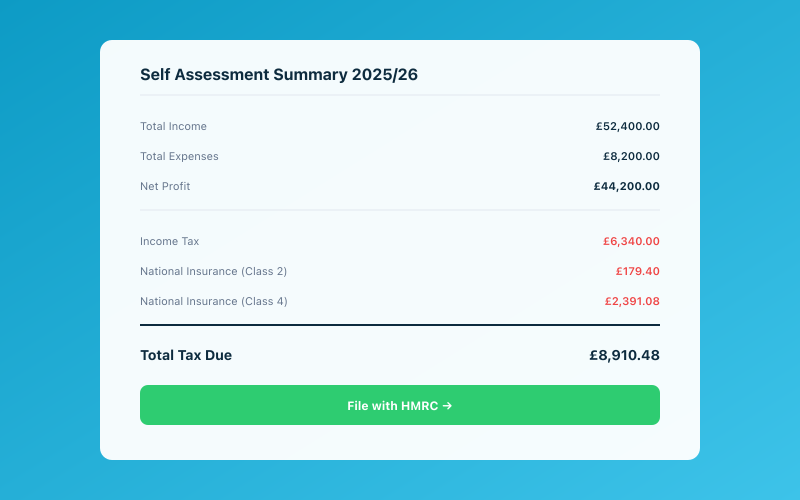 Your Accounted dashboard shows your real-time tax position
TaxCalc's heritage is firmly rooted in tax compliance. It's known for being thorough, accurate, and comprehensive in its coverage of UK tax scenarios. The software handles Self Assessment for individuals, partnerships, trusts, and companies — which gives you a sense of its breadth.
For sole traders specifically, TaxCalc offers a Self Assessment filing tool and MTD for Income Tax functionality. There's also a bookkeeping product (TaxCalc Go) aimed at smaller businesses.
What Is Accounted?
Accounted is a newer entrant, purpose-built for UK sole traders and landlords. Rather than starting from a tax filing tool and expanding outwards, Accounted was designed from the ground up as a year-round bookkeeping platform that makes tax compliance a natural output of good record-keeping.
The headline feature is Penny, an AI bookkeeper accessible through WhatsApp. Penny handles receipt capture, transaction categorisation, tax questions, and financial summaries — bringing bookkeeping into a conversational, phone-based workflow that feels nothing like traditional accounting software.
Feature-by-Feature Comparison
Target Audience
TaxCalc serves a broad audience — individuals, sole traders, partnerships, limited companies, trusts, and accountancy practices. This breadth means the platform is powerful but can feel over-engineered for a sole trader with simple needs. You're navigating an interface designed to handle corporation tax and trust returns when all you need is to track your plumbing income and van expenses.
Accounted is built exclusively for sole traders and landlords. Every screen, every feature, every workflow is designed for this specific audience. There's no clutter from features aimed at limited companies or large practices. This focus means you can get started quickly without feeling overwhelmed.
Day-to-Day Bookkeeping
TaxCalc offers bookkeeping functionality through its Go product, which includes bank feeds, transaction categorisation, and basic financial management. It's functional, though it's not the core of what TaxCalc is known for. TaxCalc's strength has always been at the filing end — getting data into HMRC-ready format.
Accounted treats bookkeeping as the foundation. Bank feeds connect via Open Banking, transactions flow in automatically, and Penny suggests categories based on the merchant and description. You approve suggestions with a tap, and your records stay up to date with minimal effort. Invoicing is built in, receipt management happens through WhatsApp, and mileage tracking is included.
For sole traders who want a tool that handles the daily stuff — not just the annual filing — Accounted is stronger here.
Receipt Management
TaxCalc allows you to attach receipts to transactions, but the workflow is relatively traditional — upload files through the web interface.
Accounted takes a completely different approach with Penny. See a receipt? Photograph it and send it to Penny on WhatsApp. Penny reads the receipt, extracts the amount, date, and merchant, categorises it, and attaches it to the right transaction. It takes seconds, and you don't need to open any app other than WhatsApp (which you're probably already using).
This might sound like a small difference, but receipt management is one of the biggest pain points in sole trader bookkeeping. Making it effortless has a compound effect on how well-maintained your records are throughout the year.
Self Assessment Filing
TaxCalc is excellent at Self Assessment. This is its heritage and its core strength. The filing workflow is thorough, with detailed guidance for each section of the return. It handles complex scenarios — multiple income sources, capital gains, foreign income — with confidence. If you have an unusually complicated tax situation, TaxCalc's depth is reassuring.
Accounted handles Self Assessment filing as part of its overall workflow. Because your books are maintained throughout the year, the Self Assessment process is largely a matter of reviewing figures that are already in place and submitting. For straightforward sole trader returns (which is most of them), this is all you need. For highly complex returns with unusual income types, TaxCalc may have an edge in coverage.
Making Tax Digital
Both platforms support MTD for Income Tax, which is the capability that matters most going forward.
TaxCalc offers MTD submission tools, and given its long relationship with HMRC, the compliance side is solid. The workflow integrates with its bookkeeping features, though the overall experience reflects the platform's filing-tool heritage.
Accounted was designed with MTD as a core consideration. Quarterly submissions flow naturally from the ongoing bookkeeping — you review the quarter's figures, confirm they're correct, and submit. Because Penny has been helping you categorise transactions throughout the quarter, there's minimal preparation needed. The process feels like a natural check-in rather than a separate compliance task.
Ease of Use
TaxCalc is powerful but can feel dense. The interface reflects its comprehensive coverage — there are a lot of options, menus, and fields. For someone who's comfortable with tax terminology and doesn't mind a learning curve, this isn't a problem. For someone who just wants to get their books done and move on, it can feel like more than they bargained for.
Accounted prioritises simplicity. The interface is clean and focused, Penny handles much of the interaction through natural conversation, and there's very little jargon to contend with. Most sole traders can set up and start using Accounted within an hour, without reading a manual or watching tutorials.
Pricing
TaxCalc pricing varies by product. The Self Assessment filing tool has one price, the bookkeeping product (Go) has another, and bundles are available. Check their website for current pricing, but be aware that you might need to pay for multiple components to get the full experience.
Accounted uses straightforward monthly pricing that includes everything — bookkeeping, invoicing, receipt capture, Penny, MTD submissions, and Self Assessment filing. No add-ons, no per-filing charges, no surprises. For sole traders who want to know exactly what they're paying, this simplicity is welcome.
Accountant Access
TaxCalc has a strong accountant-facing practice management platform. If your accountant already uses TaxCalc for their practice, having your data in the same ecosystem can be convenient.
Accounted has an accountant portal that gives your accountant direct access to your books. They can review transactions, generate reports, and see your tax position — all without needing to use Accounted themselves for practice management. It's designed to work regardless of what software your accountant uses for their other clients. For more on how accountants are approaching software choices, see our piece on why accountants are switching clients to Accounted.
Who Should Choose TaxCalc?
TaxCalc is a solid choice if:
- You have a complex tax situation with multiple income types, capital gains, or foreign income
- Your accountant already uses TaxCalc and wants data in that ecosystem
- You're comfortable with a more detailed, comprehensive interface
- You want deep control over every aspect of your tax return
- You're happy to manage bookkeeping separately or use TaxCalc Go alongside the filing tool
Who Should Choose Accounted?
Accounted is the better fit if:
- You're a sole trader or landlord with relatively straightforward finances
- You want bookkeeping and tax filing handled in one platform, end to end
- You prefer automation and AI assistance over manual data management
- You'd rather send a receipt photo on WhatsApp than log into a web app
- You want simple, transparent pricing with no add-ons
- MTD quarterly submissions should feel effortless, not like extra paperwork
For a more detailed feature breakdown, our Accounted vs TaxCalc comparison explores additional nuances.
The Practical Question
At the end of the day, the best accounting software is the one you'll actually use. If you choose something powerful but complex, and you end up avoiding it until the last minute, your records suffer. If you choose something simple and engaging — something that fits into the way you already use your phone and your time — you'll maintain better records, submit on time, and have fewer surprises at tax time.
TaxCalc is powerful and thorough. Accounted is simple and persistent (in a good way). Which matters more to you will determine which is the right choice.
For broader context on how these and other platforms compare, the best bookkeeping software UK guide covers the landscape.
Accounted helps UK sole traders stay on top of their bookkeeping and tax. Start your free 30-day trial at getaccounted.co.uk
Related reading:
Related Reading
- Is FreeAgent Really Free with NatWest? The Fine Print
- Spreadsheet to Accounting Software — Making the Jump
- Xero Pricing in 2026 — The Complete Breakdown
Compare Accounted with other platforms and start your free trial.
See how Accounted compares to Xero, Sage, QuickBooks and more — and why sole traders are switching. See the full comparison →
Editorial & Research
The Accounted editorial team covers software comparisons, technology, and the tools UK sole traders need to run their businesses efficiently. All software comparisons are based on independent research and publicly available pricing.
Ready to try Accounted?
Join UK sole traders who are simplifying their bookkeeping and tax.
Start your 14-day free trial