HMRC Payment Plans — Time to Pay Arrangements Explained
Receiving your Self Assessment tax bill can be a sobering moment — especially if the number is bigger than you expected. If you're staring at a bill you simply can't afford to pay in one go, don't panic. HMRC offers a formal arrangement called Time to Pay that lets you spread the cost over monthly instalments.
It's not a get-out-of-jail-free card, and there are conditions attached, but it's a genuinely helpful lifeline that thousands of sole traders use every year. Here's everything you need to know.
What Is Time to Pay?
Time to Pay (TTP) is an arrangement between you and HMRC that allows you to pay your tax bill in monthly instalments rather than as a single lump sum. Think of it as an official payment plan — HMRC agrees to give you more time, and you agree to pay a set amount each month until the debt is cleared.
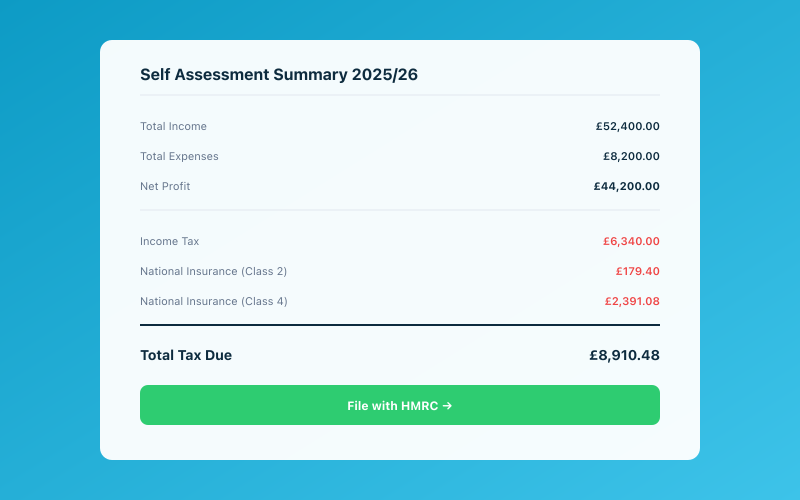 Your Accounted dashboard shows your real-time tax position
It's not a reduction in what you owe. You still pay the full amount, plus interest. But it stops HMRC from pursuing enforcement action (such as debt collection) and, importantly, it prevents late payment penalties from stacking up once the arrangement is in place.
TTP arrangements are available for Self Assessment tax, VAT, PAYE, Corporation Tax, and other HMRC debts. For the purposes of this article, we're focusing on Self Assessment, since that's what most sole traders deal with.
Who Can Set Up a Payment Plan?
To set up a TTP arrangement online (the easiest method), you need to meet all of the following criteria:
- You owe £30,000 or less in Self Assessment tax
- You're within sixty days of the payment deadline
- You've filed your tax return for the relevant year
- You don't have any other existing payment plans or debts with HMRC
- You plan to pay the debt within twelve months
If you owe more than £30,000, or you need longer than twelve months to pay, you can still apply — but you'll need to call HMRC directly rather than using the online system. The phone team has more flexibility and can agree to longer or larger arrangements on a case-by-case basis.
How to Set One Up Online
If you qualify for the online route, the process is straightforward:
- Log in to your HMRC online account at gov.uk. You'll need your Government Gateway credentials.
- Navigate to your Self Assessment account and find the option to set up a payment plan.
- Choose your instalment plan. You'll be shown options for how much to pay each month and over how many months. The system calculates the interest automatically and adds it to each instalment.
- Set up a Direct Debit. Payments are made monthly by Direct Debit, so you'll need to provide your bank details.
- Confirm the arrangement. Once you agree, the plan is in place and HMRC will collect payments automatically.
The whole process takes about fifteen minutes and can be done at any time — no need to call anyone or wait on hold.
How to Apply by Phone
If you don't qualify for the online route — perhaps you owe more than £30,000, or you've already missed the sixty-day window — you'll need to call HMRC's Payment Support Service on 0300 200 3835.
Before you call, have the following ready:
- Your Self Assessment Unique Taxpayer Reference (UTR)
- Details of what you owe and for which tax year
- A realistic proposal for how much you can pay each month
- Information about your income and essential outgoings (HMRC will want to understand your financial situation)
- Details of any savings or assets you have
Be honest about your situation. The HMRC officer will assess whether your proposal is affordable and realistic. They're more likely to agree if you can demonstrate that you've thought it through and that the amounts you're proposing are genuinely what you can afford.
What Happens to Interest?
Interest continues to accrue on the outstanding balance throughout the TTP arrangement. The current interest rate is set at the Bank of England base rate plus 2.5%, which currently works out at around 7.5% per annum.
This means a £10,000 tax bill paid over twelve months would attract roughly £400–£450 in interest on top of the original amount. It's not insignificant, but it's far less painful than the combination of late payment penalties and enforcement action you'd face without a payment plan.
The interest is calculated on a daily basis on the outstanding balance, so the sooner you start paying, the less interest you'll accrue overall.
What Happens to Penalties?
This is the crucial bit. Once a TTP arrangement is in place, HMRC will not charge further late payment penalties on the debt covered by the plan. However, any penalties that were already due before you set up the plan will still stand.
For example, if your tax was due on 31 January and you don't set up a payment plan until 15 March — more than thirty days later — you'll still face the 5% late payment surcharge for the first thirty days. But the six-month and twelve-month surcharges will be avoided because you now have an arrangement in place.
This is why it pays to act quickly. The sooner you set up a plan, the fewer penalties you'll face. Ideally, you'd arrange it before the original deadline or immediately after.
Can You Negotiate the Terms?
If you're applying online, the terms are fairly fixed — you choose how many months you want to spread the payments over (up to twelve), and the system calculates the monthly amount.
If you're applying by phone, there's more room for negotiation. HMRC can agree to:
- Payment periods longer than twelve months (in some cases, up to five years for larger debts)
- Reduced initial payments with larger payments later
- A short initial break before payments start (in exceptional circumstances)
The key factor is affordability. HMRC will want to see that your proposed payments are sustainable. There's no point agreeing to £500 a month if you can only realistically afford £300 — you'll just default on the plan, which makes everything worse.
What If You Can't Keep Up With Payments?
Life happens. If your circumstances change and you can no longer afford the agreed payments, contact HMRC immediately. Don't just stop paying and hope they won't notice — they will.
If you get in touch proactively, HMRC may agree to renegotiate the terms. Perhaps they'll extend the payment period or reduce the monthly amount. They're generally more accommodating when you communicate openly rather than going silent.
If you simply stop paying without contacting HMRC, the arrangement will be cancelled. At that point, the full outstanding balance becomes due immediately, penalties resume, and HMRC may begin enforcement action — which could include using debt collection agencies or, in extreme cases, county court judgments.
Tips for Managing Your Payment Plan
Set up a dedicated savings buffer. Once your payment plan is in place, try to build up a small buffer in case of unexpected expenses. Even £200–£300 set aside gives you breathing room.
Keep filing your returns on time. A TTP arrangement only covers the debt from a specific period. You still need to file future returns and pay future bills on time. If you miss another deadline while you're on a payment plan, it can jeopardise the existing arrangement.
Plan ahead for next year. The fact that you needed a payment plan suggests your tax bill was larger than expected. Use this as a prompt to plan better for the coming year. Setting aside money each month for tax — a common rule of thumb is 25–30% of your profit — means you won't be in the same position again.
Use software to track your liability. Accounted can help you estimate your tax throughout the year, so you know roughly what you'll owe. Penny tracks your income and expenses in real time, which means you can see your projected tax bill building month by month. No more nasty surprises in January.
When a Payment Plan Isn't Enough
If your debt is very large, or you're consistently unable to pay your tax, a TTP arrangement might not be sufficient. In these cases, it's worth seeking professional advice from an accountant or tax adviser.
Options might include:
- Reviewing your expenses to ensure you're claiming everything you're entitled to (which reduces your tax bill)
- Adjusting your payments on account if they're set too high
- Considering whether your business structure is tax-efficient
- In extreme cases, exploring formal debt solutions
The important thing is not to suffer in silence. Tax debt is stressful, but there are always options — and the earlier you address the problem, the more options you'll have.
Acting Early Is Everything
If there's one takeaway from this article, it's this: act early. The moment you suspect you might not be able to pay your tax bill in full, start thinking about a payment plan. Don't wait until the deadline has passed and penalties have started accruing.
If you file your return early and discover you owe more than expected, you've got time to set up a plan or start saving. If you leave everything to the last week of January, you're out of options.
Keeping your bookkeeping up to date throughout the year is the best way to avoid surprises. With Accounted and Penny, you can see your financial picture in real time — which means you'll never be blindsided by a tax bill you didn't see coming.
Related reading:
- How to Pay Your Self Assessment Bill
- What Happens If You Miss the Tax Return Deadline
- How to Appeal an HMRC Penalty
Accounted helps UK sole traders stay on top of their bookkeeping and tax. Start your free 30-day trial at getaccounted.co.uk.
Related Reading
- Overlap Relief — Claiming Back Tax You've Overpaid
- Voluntary Disclosure to HMRC — Coming Clean About Past Mistakes
Start your free trial and let Penny handle your bookkeeping automatically.
Accounted files your Self Assessment directly to HMRC, with your return pre-populated from your records. See Self Assessment filing →
Tax & Compliance Specialists
Our tax specialists have decades of combined experience in UK sole trader and small business taxation, MTD compliance, and HMRC submissions. All content is reviewed against current HMRC guidance before publication and updated quarterly to reflect legislative changes.
Ready to try Accounted?
Join UK sole traders who are simplifying their bookkeeping and tax.
Start your 14-day free trial