Home-Based Food Businesses — Kitchen Requirements and Tax
Selling food from your home kitchen is one of the most accessible ways to start a business. Whether you're baking cakes to order, making preserves, running a supper club, or preparing meals for delivery, the barriers to entry are lower than you might think. You don't necessarily need a commercial kitchen — in many cases, a domestic kitchen that meets hygiene standards is perfectly fine.
But there are regulations to follow, registrations to complete, and tax obligations to understand. Getting these right from the start protects your customers, protects you, and keeps you on the right side of both the local council and HMRC.
Registering Your Food Business
If you sell food regularly — even from home, even on a small scale — you must register as a food business with your local authority's environmental health department. This is a legal requirement under EU-retained food hygiene regulations (which still apply in the UK).
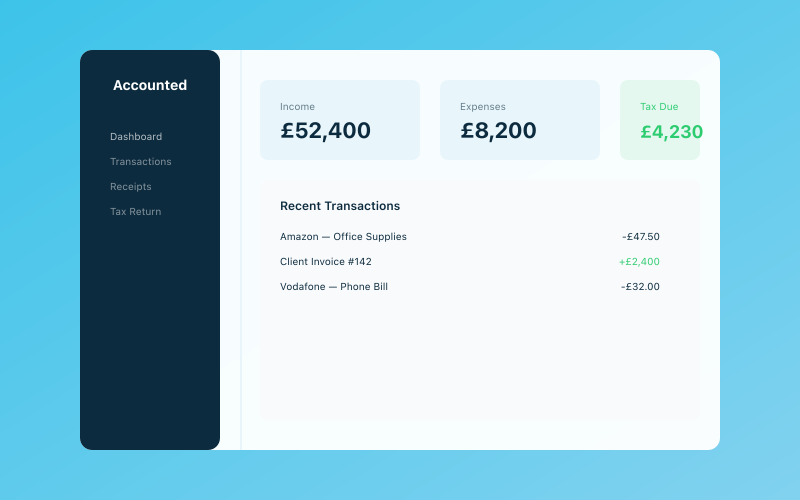 Your Accounted dashboard — income, expenses, and tax at a glance
You need to register at least 28 days before you start trading. Registration is free and can usually be done online through your council's website. You can't be refused registration — it's a notification process, not an approval process.
Once registered, your premises will be subject to inspection by an environmental health officer. They'll assess your kitchen's hygiene standards, your food safety management procedures, and your general practices. This leads to a Food Hygiene Rating (the scores on the doors system), which in Wales and Northern Ireland must be displayed. In England, it's voluntary but widely expected — and a score of 5 is a real selling point.
Separately, you need to register with HMRC as self-employed if you're trading with the intention of making a profit. This is a different registration from the food business one — you need both.
Kitchen Requirements — What the Inspector Looks For
The good news is that you don't need to build a commercial kitchen. A domestic kitchen can meet the requirements, provided it's clean, well-maintained, and properly organised.
Here's what an environmental health officer will typically look at:
Cleanliness and maintenance. Surfaces need to be clean, smooth, and easy to wipe down. Cracked tiles, peeling paint, or damaged worktops are red flags. Your kitchen doesn't need to be brand new, but it needs to be in good condition.
Hand washing facilities. You need a dedicated hand wash basin with hot water and soap. In most domestic kitchens, the main sink serves this purpose, but ideally you'd have a separate hand wash point. Anti-bacterial soap and clean towels (or a hand dryer) should be available.
Food storage. Raw and cooked foods must be stored separately to prevent cross-contamination. Your fridge needs to be running at 5°C or below, and your freezer at -18°C or below. You'll need adequate dry storage — ingredients should be in sealed containers, off the floor, and away from cleaning chemicals.
Pest control. No signs of pests — droppings, gnaw marks, or evidence of insects. Keep doors closed, food sealed, and bins emptied regularly.
Waste disposal. Adequate bin provision and regular waste collection. Food waste should be separated from general waste where possible.
Equipment. All equipment should be clean, in good working order, and suitable for commercial food production. This doesn't mean everything needs to be commercial-grade — a domestic oven and fridge are fine — but they need to be adequate for the volume you're producing.
Pets. This is a sensitive one. Having pets doesn't automatically disqualify you, but pets should be kept out of the kitchen during food preparation. Environmental health officers will look for evidence that pet hair, dander, or contamination is managed.
Food Safety Management System. You need a documented food safety management system — essentially, a record of how you manage food safety risks. The Food Standards Agency's "Safer Food, Better Business" pack is a free resource designed for small food businesses and covers everything you need. It includes diary pages for recording your checks and procedures.
Food Hygiene Training
While there's no strict legal requirement to hold a food hygiene certificate, it's strongly recommended and many local authorities and market operators require it. A Level 2 Award in Food Safety is the standard qualification. You can complete it online in a few hours for around £10-30.
The certificate covers the basics: personal hygiene, food storage, temperature control, cross-contamination prevention, and cleaning procedures. Even if you're confident in your kitchen skills, the course is worthwhile — it covers things you might not have considered, and it demonstrates professionalism to customers and inspectors alike.
If you employ anyone to help with food preparation, they'll need training too. You're responsible for ensuring that everyone who handles food in your business has adequate food safety training.
Labelling and Allergen Requirements
Food labelling regulations apply to home-based businesses just as much as they do to supermarkets — though the specific requirements depend on how you sell.
Pre-packed food (food packaged before the customer orders it) must display:
- The name of the food
- A full ingredients list, with the 14 major allergens emphasised (in bold, underline, or capitals)
- The name and address of the food business
- A best before or use by date
- Net quantity
- Any special storage conditions
- Nutritional information (with some exemptions for small businesses)
Food prepared to order (made after the customer requests it, or packaged on site at the point of sale) has different rules. You must provide allergen information, but you have more flexibility in how you do it — it can be verbal, on a menu, or on a notice.
The 14 major allergens you must declare are: celery, cereals containing gluten, crustaceans, eggs, fish, lupin, milk, molluscs, mustard, nuts, peanuts, sesame, soybeans, and sulphur dioxide. Getting allergen management wrong can have serious — potentially fatal — consequences. Take it seriously.
Natasha's Law (the UK Food Information Amendment) requires that all food prepacked for direct sale (PPDS) — food packaged before the customer selects it, at the same premises where it's sold — must have a full ingredients list with allergens emphasised. This is particularly relevant if you're selling at markets or from your doorstep.
Tax for Home-Based Food Businesses
Your food business profits are taxed in the same way as any other self-employed income. For 2025/26:
Income tax:
- Personal Allowance: £12,570 (tax-free)
- Basic rate: 20% on profits between £12,570 and £50,270
- Higher rate: 40% on profits between £50,270 and £125,140
- Additional rate: 45% above £125,140
- Class 2: £3.45 per week if profits are above £12,570
- Class 4: 6% on profits between £12,570 and £50,270, plus 2% above
VAT: If your taxable turnover exceeds £90,000 in a rolling 12-month period, you must register for VAT. Note that some food items are zero-rated for VAT (most basic foodstuffs), while others are standard-rated (catering, hot food for immediate consumption, confectionery, and certain snack foods). The VAT treatment of food is notoriously complex — the famous Jaffa Cake case being a prime example — so get advice if you're nearing the threshold.
Expenses You Can Claim
Home-based food businesses have a wide range of claimable expenses. Here are the main ones:
Ingredients and raw materials. The cost of everything you use to make your products — flour, butter, sugar, packaging, whatever it is. Keep receipts for every purchase.
Use of home. Since you're using your kitchen for business, you can claim a proportion of your household running costs. You have two options:
- Simplified expenses: Claim a flat rate based on hours worked — £10/month for 25-50 hours, £18/month for 51-100 hours, £26/month for 101+ hours
- Actual costs: Calculate the proportion of your home used for business (by room or area) and claim that percentage of rent/mortgage interest, council tax, electricity, gas, water, and insurance
For most home food businesses, actual costs give a higher deduction because the kitchen uses a disproportionate amount of gas, electricity, and water. Our guide on home working expenses walks through the calculation in detail.
Equipment. Mixers, baking trays, food processors, packaging equipment, temperature probes, storage containers — all claimable as business expenses. Items under £1,000 can typically be deducted in full in the year of purchase under the Annual Investment Allowance.
Vehicle costs. If you deliver food or drive to collect supplies, you can claim mileage at 45p per mile (first 10,000 miles) and 25p per mile thereafter, or claim actual vehicle costs proportionate to business use.
Market stall and event fees. If you sell at markets, craft fairs, or food festivals, the pitch fees are fully deductible. Our guide on starting a market stall business covers the full details.
Insurance. Public liability insurance, product liability insurance, and any other business insurance premiums.
Training and certificates. Food hygiene courses, specialist baking courses, and professional development costs.
Marketing. Website costs, social media advertising, business cards, packaging design, photography.
Accounting software. Your Accounted subscription is an allowable business expense.
Penny can help you keep track of all these expenses throughout the year, categorising transactions as they come in so you're not left trying to reconstruct your records at tax time.
Scaling Up — When the Kitchen Isn't Enough
If your business grows beyond what your home kitchen can handle, you have several options:
Shared commercial kitchens. Also called "dark kitchens" or "cloud kitchens," these are commercial kitchen spaces you can rent by the hour, day, or month. They're fully equipped, inspected, and compliant with food hygiene regulations. Costs vary from £10-25 per hour to £500-2,000 per month for a regular booking.
Converting a space at home. You could convert a garage, outbuilding, or extension into a dedicated commercial kitchen. This involves significant upfront cost but gives you full control. You'll need planning permission, building regulations approval, and a separate food business registration. The conversion costs may qualify for capital allowances.
Renting commercial premises. A permanent commercial kitchen or food production unit — the biggest commitment but necessary if you're scaling to wholesale or retail supply.
Common Mistakes to Avoid
Not registering. Trading without registering your food business is illegal and can result in prosecution. Registration is free and straightforward — there's no excuse for skipping it.
Ignoring allergens. Allergen management is a legal requirement, not a nice-to-have. One mistake can cause serious harm to a customer and destroy your business and reputation.
Underpricing. Home bakers are especially guilty of this. Once you factor in ingredients, electricity, your time, packaging, delivery, and all the invisible costs, many home food businesses make far less than they think. Price properly or you'll burn out working for less than minimum wage.
Not keeping records. Cash sales at markets, informal orders from friends and neighbours, ingredient purchases at the supermarket — everything needs recording. HMRC can and does investigate food businesses, particularly those with cash transactions. Having clear, organised records is your best defence.
Forgetting about insurance. Product liability insurance is essential for food businesses and typically costs £100-200 per year. It's a small price for peace of mind.
A home food business can be incredibly rewarding. Just make sure the legal, hygiene, and financial foundations are solid, and you'll set yourself up for long-term success.
Related Reading
View our pricing and start your free 30-day trial today.
Accounted helps UK sole traders stay on top of their bookkeeping and tax. Start your free 30-day trial at getaccounted.co.uk.
Starting out? Accounted is built for UK sole traders from day one — from £14/month. Get started →
Business & Operations Advisors
Our business advisors cover the practical side of running a UK sole trader business — from HMRC registration to managing growth. Content is written for real business owners in plain English, not accountants.
Ready to try Accounted?
Join UK sole traders who are simplifying their bookkeeping and tax.
Start your 14-day free trial